
 Anna Louise
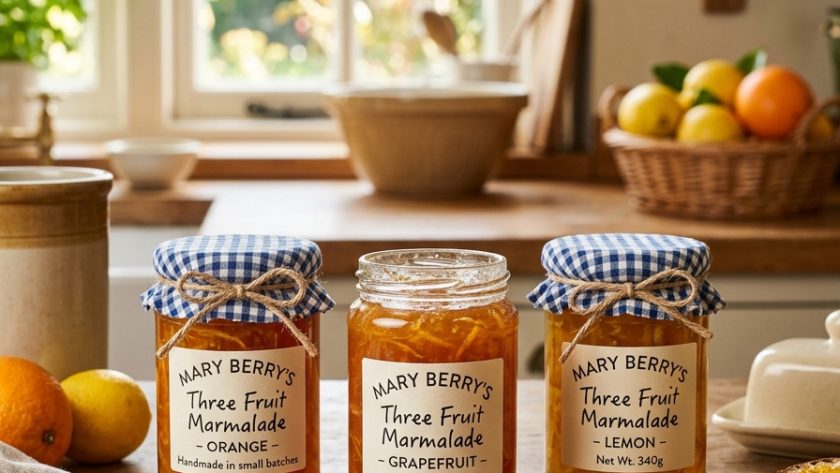
 Three fruit marmalade is the preserve that most serious marmalade makers consider the finest of all the marmalades. Where a single-fruit Seville orange marmalade is sharp and bitter and a lemon marmalade is vivid and sweet.
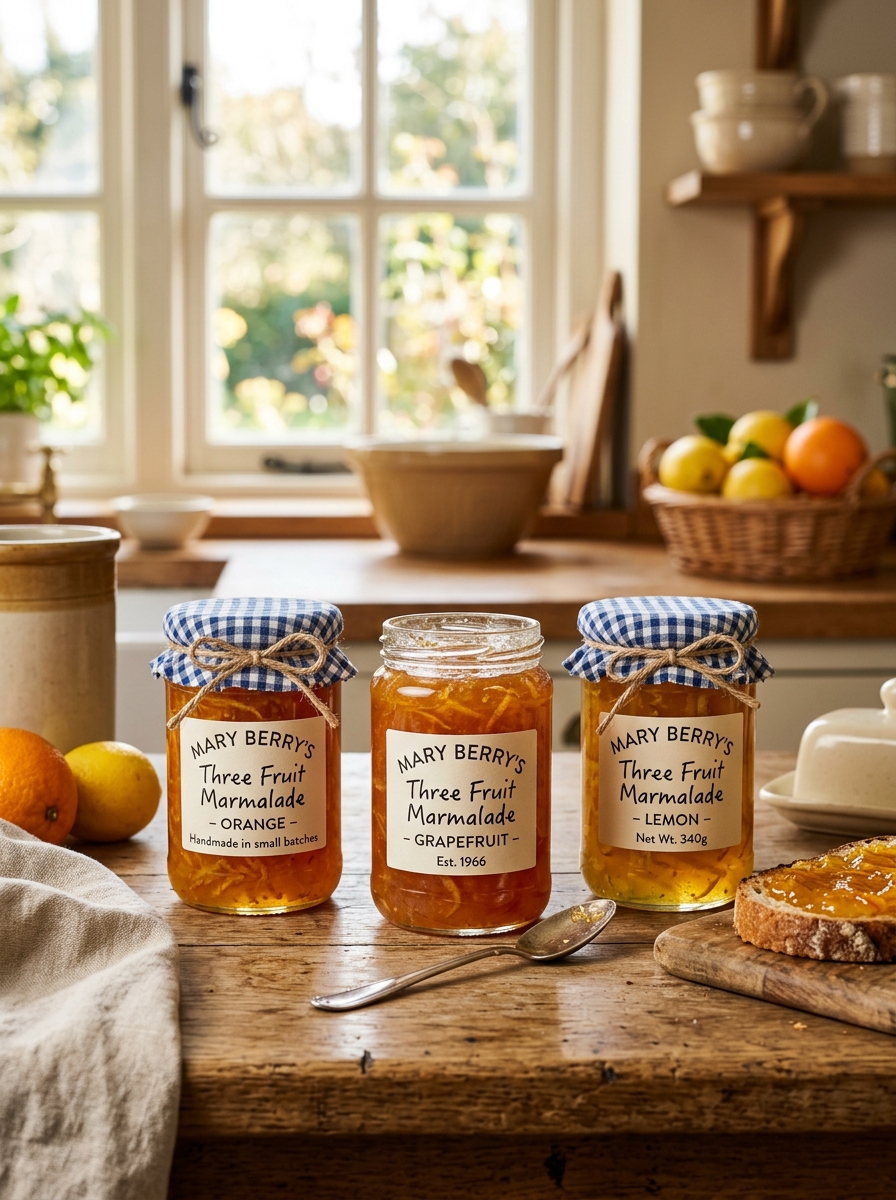
Three fruit marmalade — Seville oranges, lemons, and grapefruit — combines the bitterness of the orange, the sharpness of the lemon, and the slightly more gentle, floral bitterness of the grapefruit into something more complex and more interesting than any one fruit alone.
This is a preserve that requires patience. The fruit must be cooked until completely tender before any sugar goes in — this is the step most often rushed and the one that most consistently explains disappointing marmalade.
Under-cooked peel never softens further once the sugar is added. Properly cooked peel, by contrast, gives a marmalade with that perfect, tender-chewy peel in a bright, bittersweet jelly that is the defining character of a great marmalade.
The marmalade season runs from January to March when Seville oranges are available — small, rough-skinned, intensely fragrant, and too bitter to eat but completely transformative when preserved with sugar.
Ingredients for Mary Berry Three Fruit Marmalade
For the Marmalade (Makes approximately 8 x 450g jars)
- 500g Seville oranges — washed
- 2 large unwaxed lemons — washed
- 1 large grapefruit — washed
- 2 litres cold water
- 1.5kg granulated sugar — warmed in a low oven
- Juice of 1 extra lemon — added at the end to sharpen the set
How to Make Mary Berry Three Fruit Marmalade
Step 1 — Prepare the Fruit
Halve all the fruit. Squeeze the juice from each half into a large preserving pan or very large heavy-based saucepan — squeezing through a sieve to catch the pips. Collect all the pips in a square of muslin — they contain pectin and are essential for setting the marmalade. Tie the muslin bag securely.
Using a sharp knife or scissors, cut the squeezed fruit halves into thin shreds — as thin or as chunky as you prefer. Most people prefer fine-cut marmalade — 2 to 3mm shreds. Chunky marmalade uses 5 to 8mm shreds. The choice is entirely personal.
Step 2 — Long Initial Cook
Place the shredded peel and all the squeezed juice into the preserving pan. Add the muslin bag of pips. Pour in the 2 litres of cold water. Bring to the boil, then reduce to a simmer.
Cook uncovered for 1 hour 30 minutes to 2 hours until the peel is completely tender — a piece of peel should be completely soft when pressed between your fingers, with no resistance at all. This step cannot be rushed. The peel must be completely tender before the sugar goes in.
Remove the muslin bag — squeeze it firmly against the side of the pan with the back of a spoon to extract all the pectin-rich liquid. Discard the bag.
Step 3 — Add the Warm Sugar
Add the warmed granulated sugar and the juice of the extra lemon to the pan. Stir continuously over a medium heat until every grain of sugar has completely dissolved — test by running a wooden spoon along the base of the pan. The liquid should feel smooth with no graininess.
Once the sugar is dissolved, increase the heat to high and bring to a vigorous, rolling boil — a boil that cannot be stirred down.
Step 4 — Boil to Setting Point
Boil vigorously — stirring occasionally — for 15 to 25 minutes. Begin testing for setting point after 15 minutes.
The wrinkle test: Place a teaspoon of marmalade on a cold plate from the freezer. Leave for one minute. Push with your finger — if the surface wrinkles and the marmalade does not flood back immediately, setting point has been reached. If it floods back immediately, boil for another five minutes and test again.
Sugar thermometer test: Setting point is 104–105°C on a sugar thermometer.
Step 5 — Pot and Seal
Remove from the heat when setting point is reached. Leave to stand for fifteen minutes — this allows the peel to distribute evenly through the marmalade rather than all floating to the top of the jars.
Stir gently to distribute the peel. Pour into warm sterilised jars. Seal immediately with wax discs and cellophane covers or sterilised lids.
Leave to cool completely. Label with the date. Store in a cool, dark place.
My Top Tips For Perfect Three Fruit Marmalade
Cook the peel until genuinely, completely tender before adding sugar. Press a piece of peel firmly between thumb and finger — it must squash completely flat with no resistance. Peel that has not reached this point will not soften further once the sugar is added. Two hours of simmering is not too long for this step.
Warm the sugar before adding. Cold sugar added to the pan drops the temperature and takes longer to dissolve. Sugar warmed in a low oven — 140°C for fifteen minutes — dissolves more quickly and reduces the time the marmalade needs to reach a rolling boil.
Use Seville oranges in season. Seville oranges are available from January to March — a very short window. Their high pectin and high acid content gives a marmalade that sets reliably and has the characteristic bitter complexity that sweet oranges cannot replicate.
The muslin bag of pips is essential for setting. Orange, lemon, and grapefruit pips are extraordinarily high in pectin — the natural setting agent. The muslin bag releases this pectin into the marmalade during the long initial cook. Do not discard the pips before cooking.
Fifteen minutes of standing before potting distributes the peel. Marmalade poured into jars immediately after reaching setting point has all the peel floating at the top of each jar. Fifteen minutes of cooling — during which the marmalade thickens slightly — keeps the peel suspended evenly throughout each jar.
Serving Suggestions
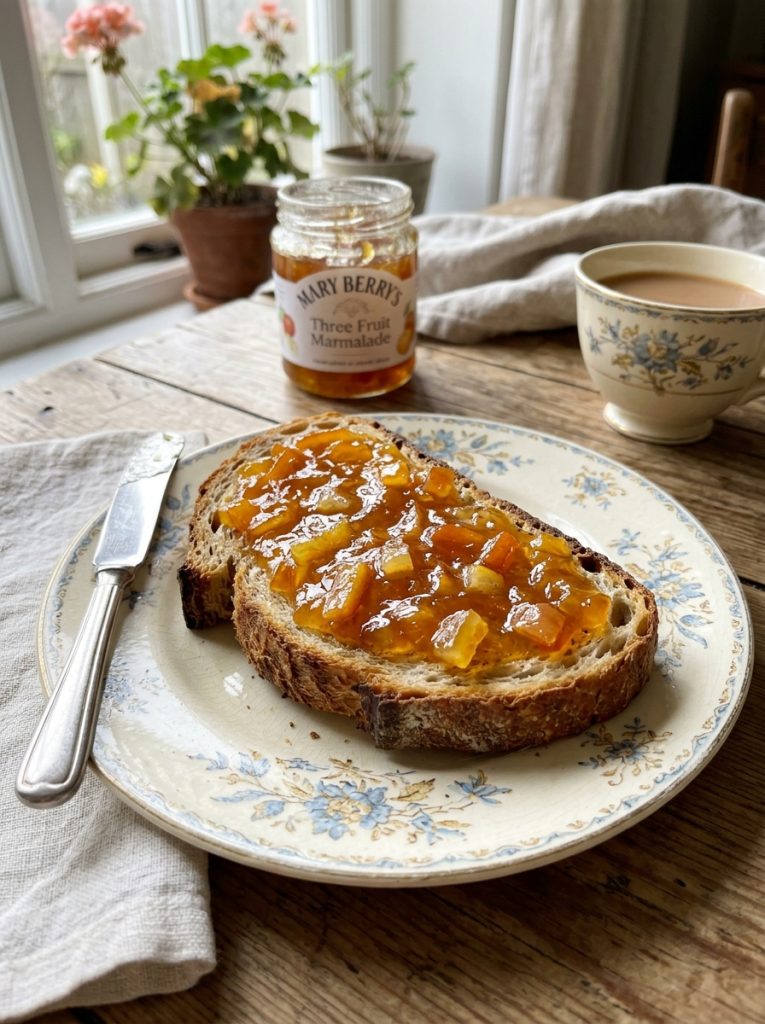
On hot buttered toast — the only correct application for marmalade. Stirred into a glaze for roasting duck or pork. Used as a filling in a sponge cake — marmalade sponge is excellent. Spread on crumpets. Given as gifts — home-made marmalade in a labelled jar with a ribbon is one of the most appreciated gifts possible.
How to Store
Sealed in sterilised jars: Keeps for up to 12 months in a cool, dark place.
Opened jar: Refrigerate and use within 4 weeks.
Try These Recipes
- Mary Berry Chocolate Yule Log
- Mary Berry Plum Chutney
- Mary Berry Piccalilli
- Mary Berry Seville Orange Marmalade
Mary Berry Three Fruit Marmalade Recipe
Ingredients
Method
- Halve all fruit — squeeze juice into preserving pan through a sieve. Collect all pips in a tied muslin bag. Shred squeezed peel to preferred thickness — 2–3mm for fine-cut, 5–8mm for chunky.
- Add peel, juice, muslin bag, and water to pan. Bring to boil — reduce to simmer. Cook uncovered 1 hour 30 minutes to 2 hours until peel is completely tender — no resistance when pressed firmly between fingers.
- Remove muslin bag — squeeze firmly against pan to extract all pectin-rich liquid. Discard bag.
- Add warmed sugar and extra lemon juice. Stir over medium heat until every grain dissolves completely — no graininess on the base.
- Increase heat — bring to a vigorous rolling boil. Boil 15–25 minutes. Test at 15 minutes using the wrinkle test on a cold plate or 104–105°C on a thermometer. Continue boiling and testing until setting point is reached.
- Remove from heat. Stand 15 minutes — stir gently to distribute peel. Pour into warm sterilised jars. Seal immediately. Cool completely. Label and store.
Notes
Frequently Asked Questions
Can I make marmalade without Seville oranges?
Seville oranges are the traditional, best choice for marmalade — their high pectin, high acid, and intense bitterness gives the characteristic set and flavour. Navel or sweet oranges can be used but give a softer set and a sweeter, less complex result. Add extra lemon juice for acidity.
What if my marmalade does not set?
Return it to the pan and boil again for five to ten minutes. Test again. If it still does not set, add the juice of another lemon — the extra acid helps the pectin to set. As a last resort, add a little liquid pectin according to the packet instructions.
Can I freeze marmalade?
Yes — freeze in small containers for up to 12 months. Defrost overnight in the fridge.
How do I sterilise jars?
Wash in hot soapy water. Rinse thoroughly. Place in a 140°C oven for fifteen minutes. Use immediately while still hot.













Leave a Reply