
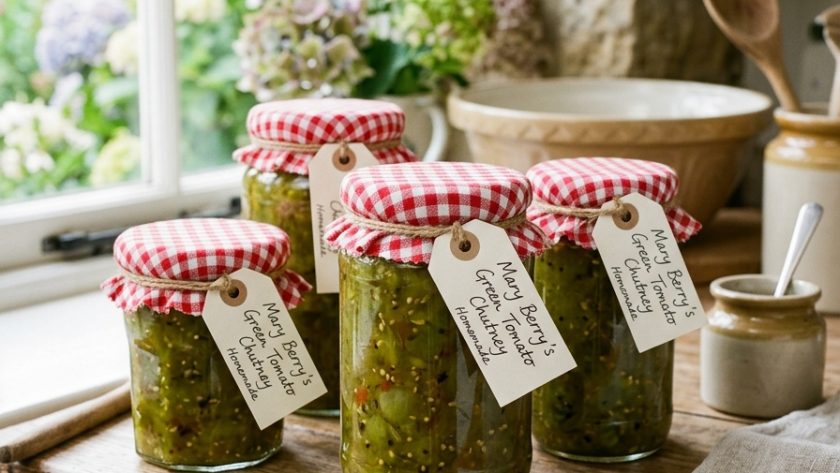
 Anna Louise
 Green tomato chutney is what I make every September when the summer is ending, the temperatures are dropping, and the tomato plants in the garden or the allotment are still carrying fruit that will never ripen before the first frosts.
It is one of the most satisfying preserves I make all year — because it takes something that would otherwise go to waste and transforms it into a deeply flavoured, spiced chutney that will improve for months and be genuinely wonderful with cheese, cold meats, and pies throughout the winter.
Green tomatoes have a sharpness and a firmness that ripe tomatoes do not — and it is precisely those qualities that make them exceptional for chutney.
They hold their shape during the long, slow cooking, releasing their sharpness gradually into the surrounding spiced vinegar, and they give a chutney with a clean, vivid acidity that shop-bought versions rarely achieve.
This chutney improves significantly over the first month and is genuinely extraordinary after three months. Make it in early autumn. Open the first jar at Christmas.
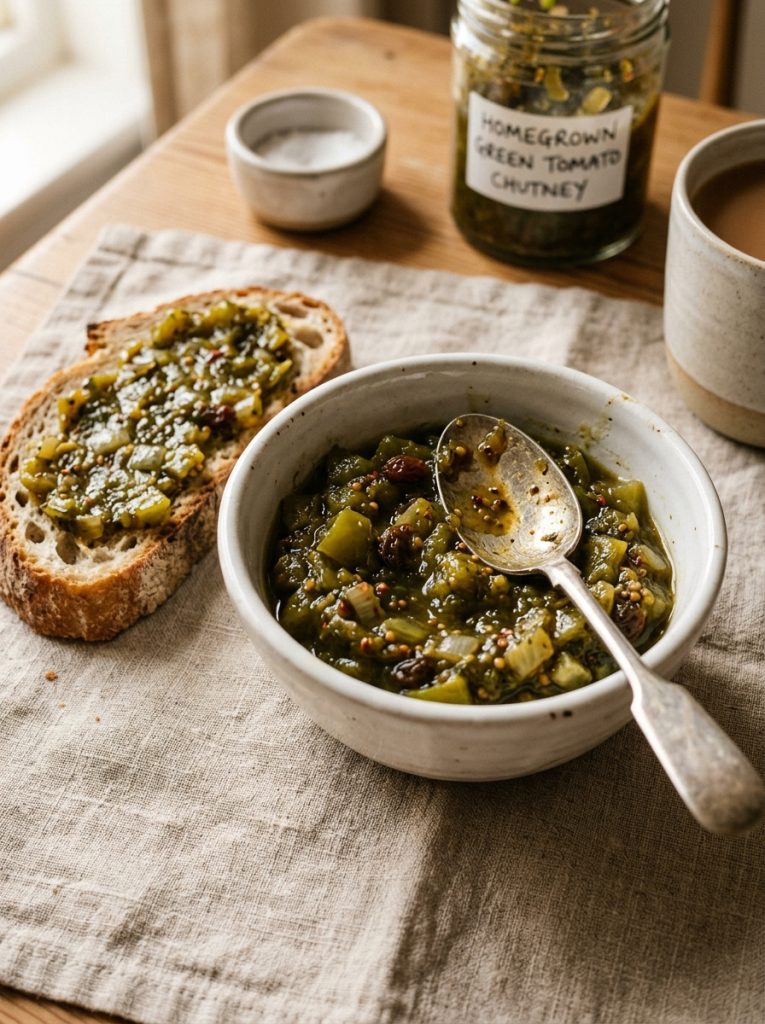
Ingredients for Mary Berry Green Tomato Chutney
For the Chutney (Makes approximately 6 x 300g jars)
- 1.5kg green tomatoes, roughly chopped into 1–2cm pieces
- 500g cooking apples, peeled, cored, and roughly chopped
- 300g onions, finely chopped
- 300g sultanas
- 400g soft dark brown sugar
- 400ml malt vinegar — or cider vinegar for a slightly more delicate result
- 3 garlic cloves, crushed
- 2cm fresh ginger, finely grated
- 1 tsp ground ginger
- 1 tsp ground allspice
- 1 tsp ground cinnamon
- ½ tsp ground cloves
- ½ tsp cayenne pepper — adjust to taste
- 1½ tsp fine salt
- 1 tsp mustard seeds
How to Make Mary Berry Green Tomato Chutney
Step 1 — Prepare and Combine
Place the chopped green tomatoes, cooking apples, onions, sultanas, garlic, and fresh ginger in a large preserving pan or heavy-based saucepan.
Add all the spices, the salt, the mustard seeds, the sugar, and the malt vinegar. Stir everything together until the sugar begins to dissolve into the liquid.
Step 2 — Long, Slow Cook
Bring to the boil over a medium heat, stirring occasionally to ensure the sugar dissolves completely without catching on the base. Once the chutney is boiling, reduce the heat to a steady, gentle simmer.
Cook uncovered — stirring every fifteen minutes — for 1 hour 30 minutes to 2 hours. The chutney is ready when it has reduced significantly, the liquid has thickened to a syrupy consistency, and a wooden spoon dragged across the base of the pan leaves a clear channel that holds for three to four seconds before the chutney flows back.
I always check using this channel test rather than relying on time alone — the exact cooking time varies depending on the water content of the tomatoes and the width of the pan. When the channel holds, the chutney is ready.
Step 3 — Pot and Seal
Remove from the heat. Leave to stand for five minutes — the chutney thickens very slightly as it cools.
Stir gently and ladle into warm, sterilised jars — filling to within 1cm of the top. Seal immediately with vinegar-proof lids. Do not use standard metal lids without a plastic coating — the vinegar corrodes them and contaminates the chutney over time.
Leave to cool completely. Label with the date and the name. Store in a cool, dark place for at least one month before opening.
My Top Tips For Best Green Tomato Chutney
Do not rush the long cook. Chutney that has not cooked long enough is thin, watery, and lacks the deep, concentrated flavour that comes from a proper slow reduction. The 1 hour 30 minutes to 2 hours is not an estimate — it is the time needed to evaporate the excess liquid and concentrate the flavours. Watch for the channel test rather than the clock.
Use vinegar-proof lids. Standard metal lids corrode in contact with the vinegar in the chutney and give an unpleasant metallic taste over time. Purpose-made vinegar-proof lids — usually with a plastic coating on the underside — are available from good kitchen shops and are essential for any vinegar-based preserve.
The channel test is the most reliable indicator of readiness. Drag a wooden spoon firmly across the base of the pan. If the channel fills back immediately, the chutney needs more time. If it holds for three to four seconds before the chutney slowly flows back, it is ready. If it holds indefinitely, it may be slightly overcooked — remove from the heat immediately.
Leave for at least one month before opening. Fresh chutney can taste slightly harsh and slightly raw from the vinegar. One month of maturing in the jar mellows the vinegar, integrates the spices, and gives the rich, complex, properly balanced chutney that makes green tomatoes genuinely worth preserving.
Use malt vinegar for a classic British result. Malt vinegar gives the deep, slightly sweet, characteristically British chutney flavour. Cider vinegar gives a slightly more delicate, slightly more apple-forward result. Both are good — malt vinegar gives the more traditional character.
Serving Suggestions
With a cheese board — this is its finest application. With cold cuts at Christmas. In a cheese and chutney sandwich. As part of a ploughman’s lunch. As a gift — two or three jars in a box with a handwritten label is a wonderful present.
How to Store Green Tomato Chutney
Sealed, unopened jars: Store in a cool, dark place for up to 12 months.
Opened jar: Refrigerate and use within 6 weeks.
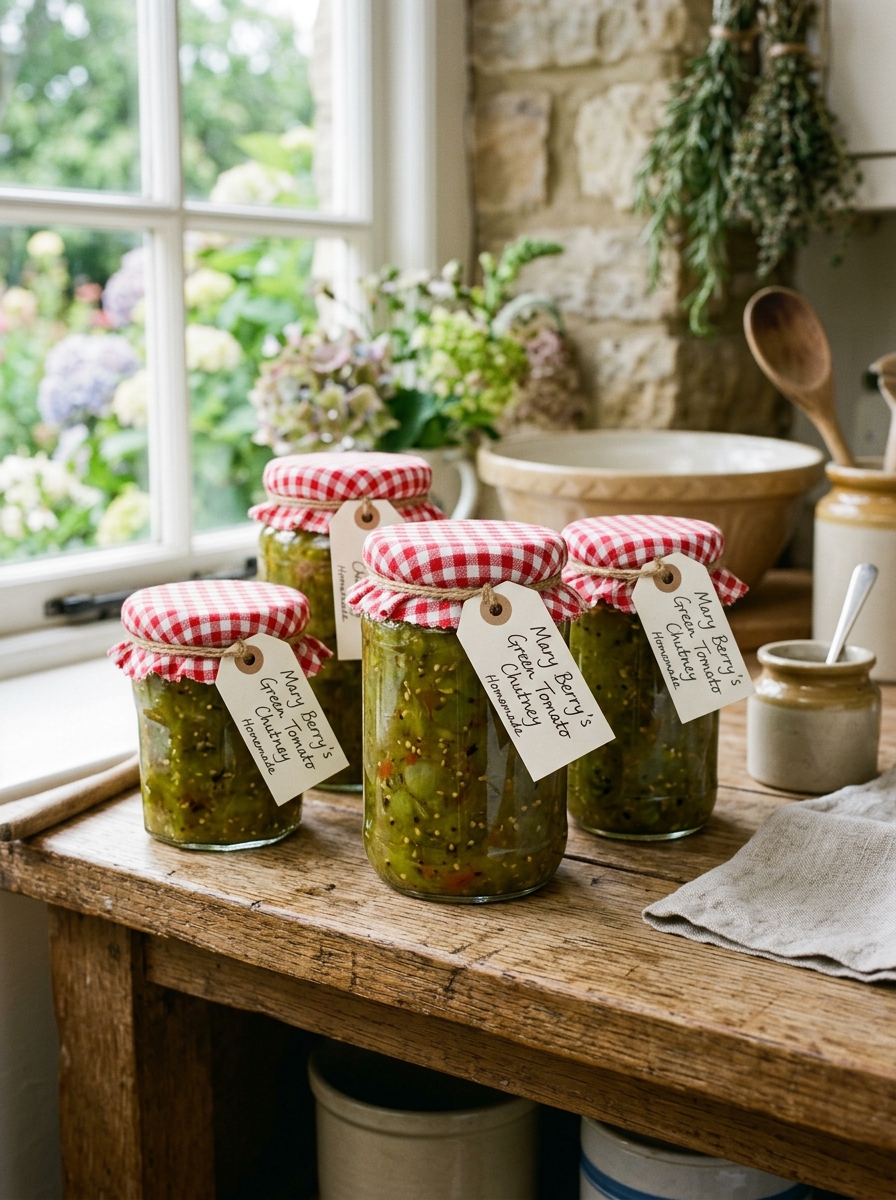
Mary Berry Green Tomato Chutney Recipe
Ingredients
Method
- Place all ingredients in a large preserving pan — stir to begin dissolving the sugar.
- Bring to the boil over medium heat — stir until sugar is fully dissolved. Reduce to a gentle simmer.
- Cook uncovered 1 hour 30 minutes to 2 hours, stirring every 15 minutes. Test with the channel test — drag a spoon across the base. Ready when the channel holds for 3–4 seconds.
- Remove from heat. Stand 5 minutes. Ladle into warm sterilised jars — fill to within 1cm of top. Seal immediately with vinegar-proof lids. Cool completely. Label and store.
- Leave at least 1 month before opening.
Notes
Frequently Asked Questions
Can I use red tomatoes that have just started to turn?
Partially ripe tomatoes give a slightly less sharp result but work perfectly well. Fully ripe red tomatoes give a sweeter, softer chutney that is completely different in character — pleasant but not what a green tomato chutney should be.
Can I use white wine vinegar instead of malt?
Yes — white wine vinegar gives a lighter, cleaner result that is less characteristically British but very good. Increase the sugar by 25g to compensate for the slightly sharper acidity.
Can I reduce the cayenne?
Yes — the half teaspoon gives a mild warmth that most people find pleasant rather than hot. Reduce to a quarter teaspoon for a completely mild version or omit entirely.
How do I sterilise jars?
Wash in hot soapy water, rinse thoroughly, and place upright in a 140°C oven for fifteen minutes. Fill immediately while still hot.
















Leave a Reply