
 Anna Louise
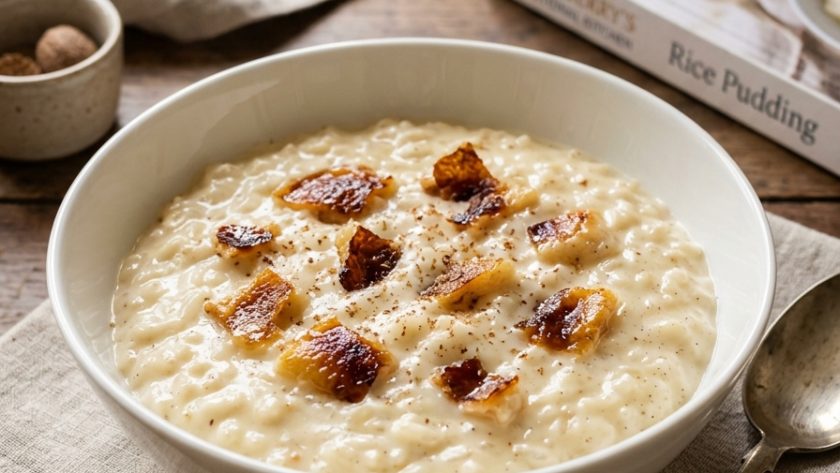
 Rice pudding is one of those things that divides people into two very clear camps. Those who love it — who remember it from childhood school dinners or from a grandmother’s kitchen, who find it deeply comforting and completely satisfying — and those who have only ever had the tinned version and have no idea what they are missing.
If you are in the second camp, this recipe is for you. Because a properly made baked rice pudding — whole milk, a little double cream, pudding rice, sugar, vanilla, and nothing else.
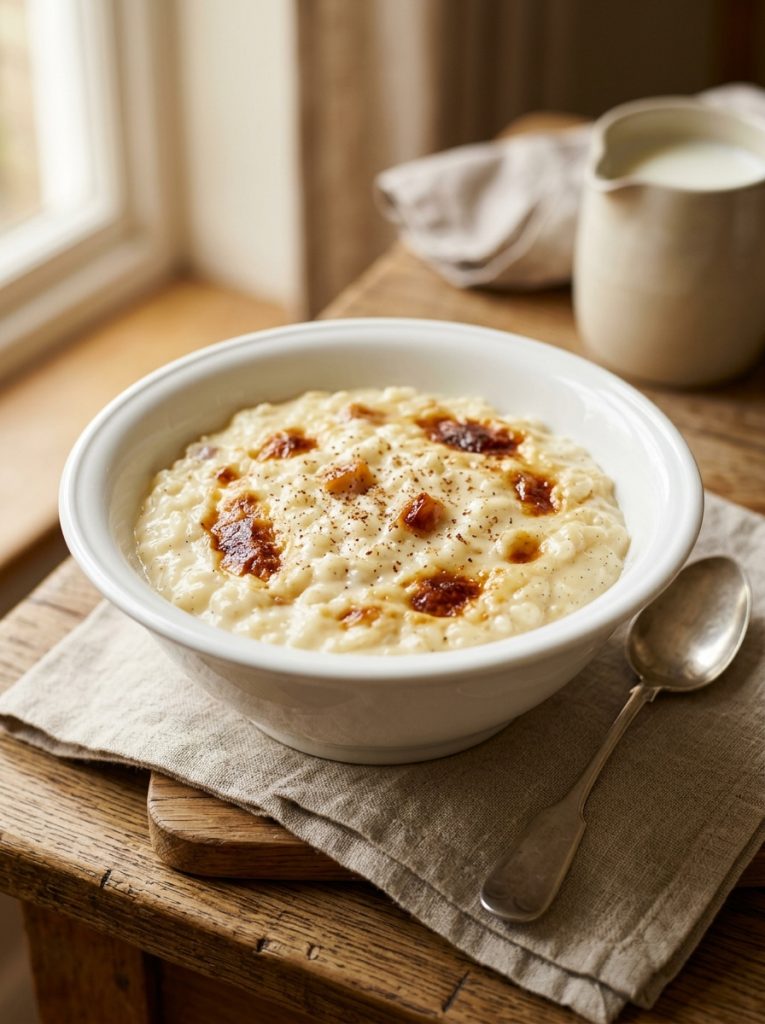
Slow-baked in the oven for two hours until the rice has absorbed most of the liquid and become thick and creamy, with a golden skin on top that you either eat enthusiastically or push to the side depending on your persuasion — is one of the finest puddings British cooking has ever produced.
It is also one of the simplest. You stir everything together, put it in the oven, and wait. The oven does everything.
The Skin Is the Best Part
I realise this is a controversial position. The skin on top of a baked rice pudding — that golden, slightly nutty, slightly caramelised layer that forms as the surface of the pudding slowly dries during baking — is for many people the thing they push to the side or eat apologetically.
I disagree completely. The skin is the best part. It has a concentration of flavour and a unique texture that the creamy rice beneath cannot replicate. I always eat mine. I often eat other people’s if they are not watching.
If you genuinely dislike the skin, stir the pudding once or twice during baking and it will not form as dramatically. But try it once before deciding.
Ingredients for Mary Berry Traditional UK Rice Pudding
For the Rice Pudding
- 100g pudding rice (short-grain rice — not long-grain, not basmati)
- 900ml whole milk
- 150ml double cream
- 50g golden caster sugar
- 1 tsp vanilla extract or ½ vanilla pod, split and seeds scraped
- 20g unsalted butter, cut into small pieces
- A little freshly grated nutmeg for the top
Optional Serving Accompaniments
- A large spoonful of strawberry or raspberry jam — the absolute classic
- A dollop of clotted cream for something even more indulgent
- Stewed rhubarb — sharp against the sweet cream
- A drizzle of honey
How to Make Mary Berry Traditional UK Rice Pudding
Step 1 — Preheat and Prepare
Preheat your oven to 150°C / 130°C fan / Gas 2. Generously butter a 1.5 litre ovenproof dish — a wide, shallow dish gives more skin surface area, which I consider a positive thing. A deeper, narrower dish gives a thicker, creamier pudding with less skin.
Step 2 — Rinse the Rice
Place the pudding rice in a sieve and rinse briefly under cold water. This removes some of the surface starch and gives a slightly cleaner, creamier pudding rather than a gluey one. Pat dry or leave to drain.
Step 3 — Combine Everything
Place the rinsed pudding rice in the buttered dish. Add the sugar and vanilla extract or vanilla seeds. Pour over the whole milk and double cream. Stir gently to combine.
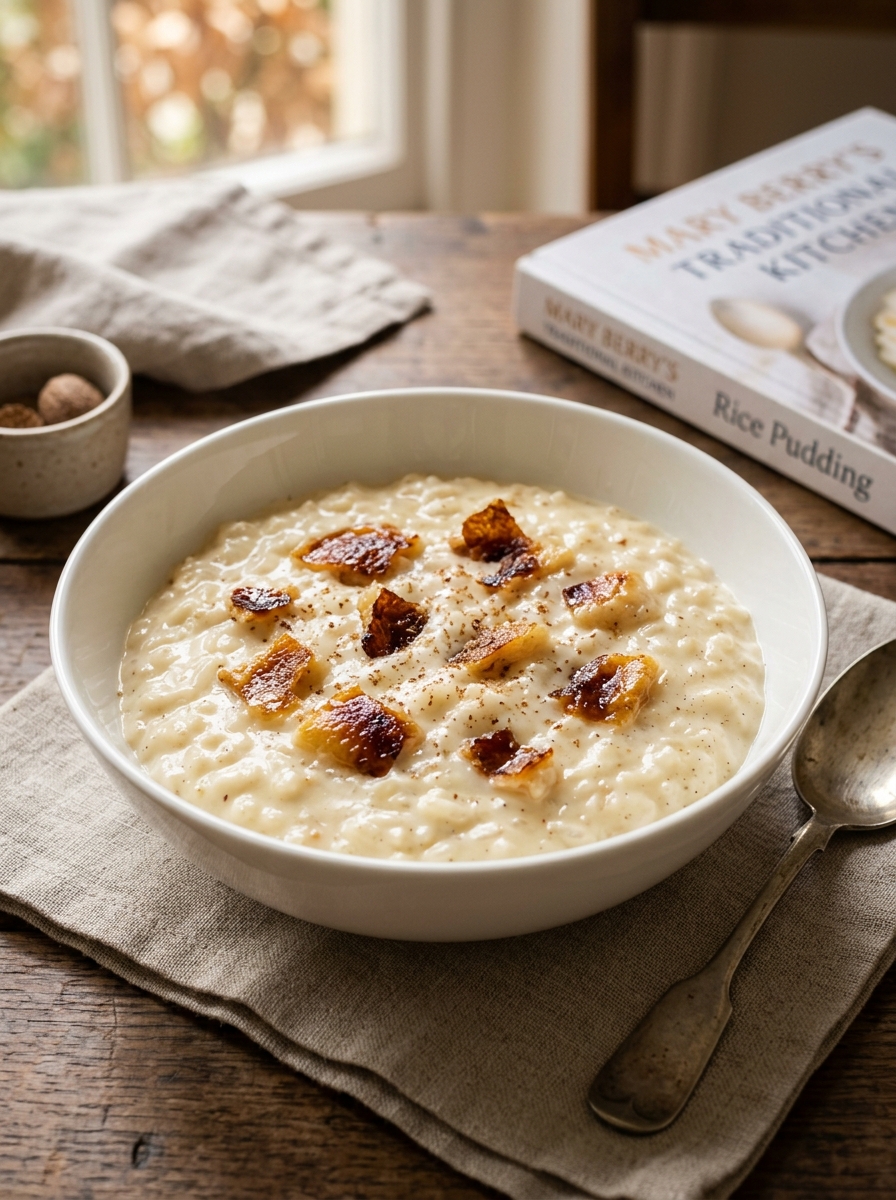
Dot the butter pieces over the surface. Grate a generous amount of fresh nutmeg over the top — the nutmeg is not optional. It gives the pudding its traditional warmth and fragrance.
Step 4 — Bake Low and Slow
Bake for 30 minutes at 150°C. After 30 minutes, stir the pudding gently — this distributes the rice and cream mixture and prevents the rice from sinking to the bottom before the skin has a chance to form properly.
Reduce the oven temperature to 140°C / 120°C fan / Gas 1. Continue baking for a further 1 hour 30 minutes to 2 hours, without stirring again, until the skin is deep golden and the rice beneath is thick, creamy, and completely tender when tasted.
The pudding should look almost set but still have a slight wobble when the dish is moved.
Step 5 — Rest and Serve
Leave to stand for five to ten minutes out of the oven before serving — the pudding thickens slightly as it cools and is at its creamiest and most perfect just slightly warm rather than piping hot.
Serve in generous spoonfuls with a big dollop of strawberry jam alongside — or whatever accompaniment you prefer.
My Top Tips For Perfect UK Rice Pudding
Use pudding rice — no substitutes. Short-grain pudding rice is specifically bred for this kind of slow cooking — it has a high starch content that releases during the long bake and gives the pudding its characteristic thick, creamy consistency. Long-grain rice stays separate and gives a completely different result. Basmati goes mushy. Pudding rice only.
Whole milk and double cream together. Whole milk alone gives a thinner, less rich pudding. Double cream alone would be too rich and too fatty. The combination of 900ml whole milk and 150ml double cream gives exactly the right balance — rich without being cloying, creamy without being heavy.
Grate the nutmeg fresh. Pre-ground nutmeg is almost tasteless compared to freshly grated from a whole nutmeg. If you have a whole nutmeg and a fine grater, use them. The difference is significant.
Stir once at 30 minutes — then leave it alone. One gentle stir after the first 30 minutes redistributes the rice and prevents it from all sinking to the base before the baking has properly started. After that, leave it completely undisturbed so the skin can form and set properly.
Serve just below piping hot. Rice pudding at a slight warm — five to ten minutes out of the oven — is at its creamiest, most voluptuous best. Piping hot it can be slightly grainy. Cold from the fridge it firms up considerably. The ideal moment is the few minutes after it comes out of the oven.
Jam alongside — always. A large spoonful of good strawberry or raspberry jam alongside a bowl of rice pudding is not just nostalgia. The sharp jam against the sweet cream is a balance that genuinely works and makes the pudding taste more complete.
Serving Suggestions
With a large spoonful of strawberry jam — the most traditional and the best. With stewed rhubarb for a spring version. With a drizzle of runny honey and a few toasted flaked almonds.
As a pudding after a Sunday roast — it bakes in the oven alongside the potatoes and needs nothing from you.
How to Store Traditional UK Rice Pudding
In the fridge: Store covered for up to 3 days. Cold rice pudding thickens considerably — stir in a little warm milk when reheating to loosen it back to a creamy consistency.
Reheating: Gently in a saucepan with a splash of milk, stirring constantly, or in the microwave with a splash of milk.
Freezing is not recommended — rice pudding becomes grainy and watery when frozen and defrosted.
Try These Recipes
- Mary Berry Lemon Curd Cheesecake
- Mary Berry 3 Egg Victoria Sponge
- Mary Berry Carrot Cake Tray Bake
- Mary Berry Blackberry And Apple Crumble
Mary Berry Traditional UK Rice Pudding Recipe
Ingredients
Method
- Preheat oven to 150°C / 130°C fan / Gas 2. Butter a 1.5 litre ovenproof dish generously.
- Place rinsed pudding rice in the dish. Add sugar and vanilla. Pour over whole milk and cream. Stir gently to combine. Dot butter pieces over the surface. Grate fresh nutmeg generously over the top.
- Bake at 150°C for 30 minutes. Stir gently once.
- Reduce oven to 140°C / 120°C fan / Gas 1. Bake without stirring for a further 1 hour 30 minutes to 2 hours until the skin is deep golden and the rice beneath is thick, creamy, and tender.
- Rest 5–10 minutes. Serve warm with strawberry jam alongside
Notes
Frequently Asked Questions
Can I make rice pudding on the hob instead of in the oven?
Yes — combine everything in a heavy-based saucepan. Cook over a very low heat, stirring frequently, for 30 to 40 minutes until the rice is tender and the pudding is thick and creamy. It will not have a skin but will be equally delicious. Keep the heat very low and do not walk away — it catches quickly.
Can I make this dairy-free?
Yes — use oat milk in place of whole milk and oat cream in place of double cream. The result is slightly less rich but still very good. The skin will not form in the same way.
Why is my rice pudding watery?
Either the oven temperature was too high and the milk boiled rather than simmered gently, or it was not baked for long enough. At 140°C, the pudding should bubble very gently — almost imperceptibly. Give it the full two hours.
Can I add flavourings?
Yes — a strip of lemon or orange zest added with the milk gives a fragrant citrus note. A cinnamon stick does the same with warm spice. Remove before serving.
Can I use condensed milk?
You can replace some of the sugar and some of the cream with sweetened condensed milk. It gives a richer, more intensely sweet result. Replace the 50g sugar and 150ml cream with one 170g tin of condensed milk.















Leave a Reply