
 Anna Louise
 I have been making cottage pie my whole adult life. It is one of those dishes that I know inside out — the mince, the vegetables, the rich gravy, the mashed potato on top. It is deeply familiar and completely reliable.
And then someone suggested making it with dauphinoise potatoes on top instead of mash. I dismissed the idea as unnecessary. Then I tried it. And now I cannot make cottage pie any other way.
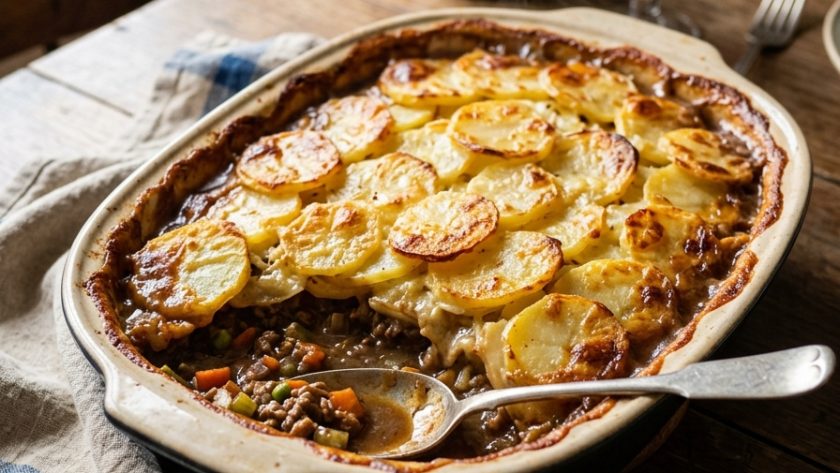
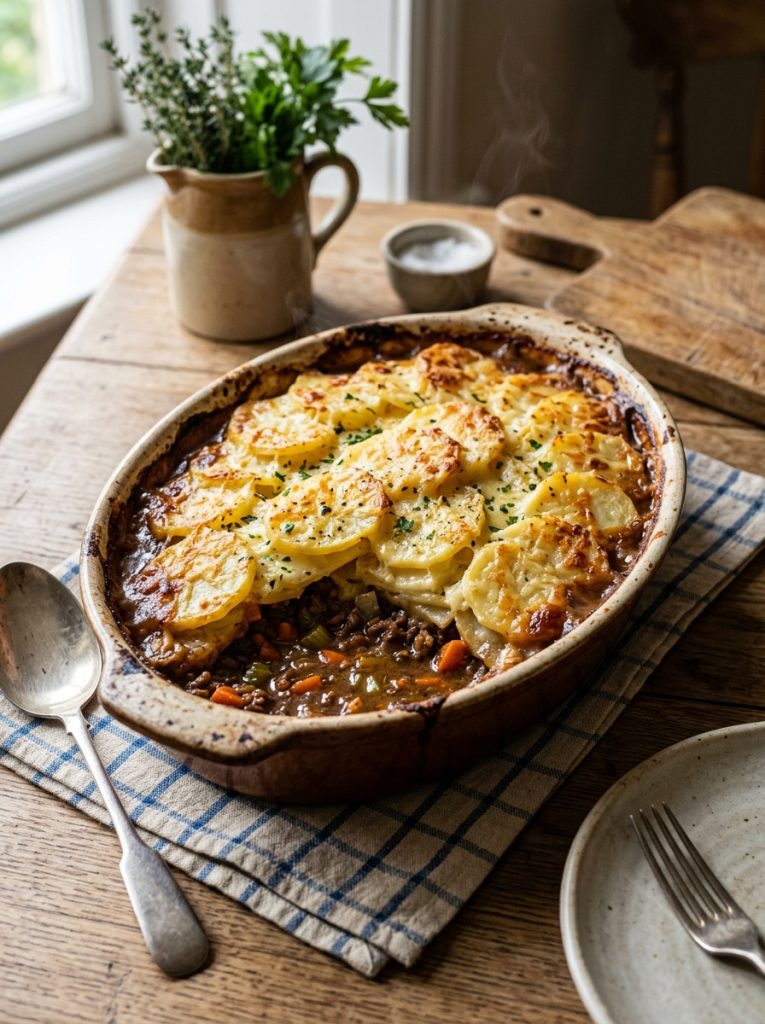
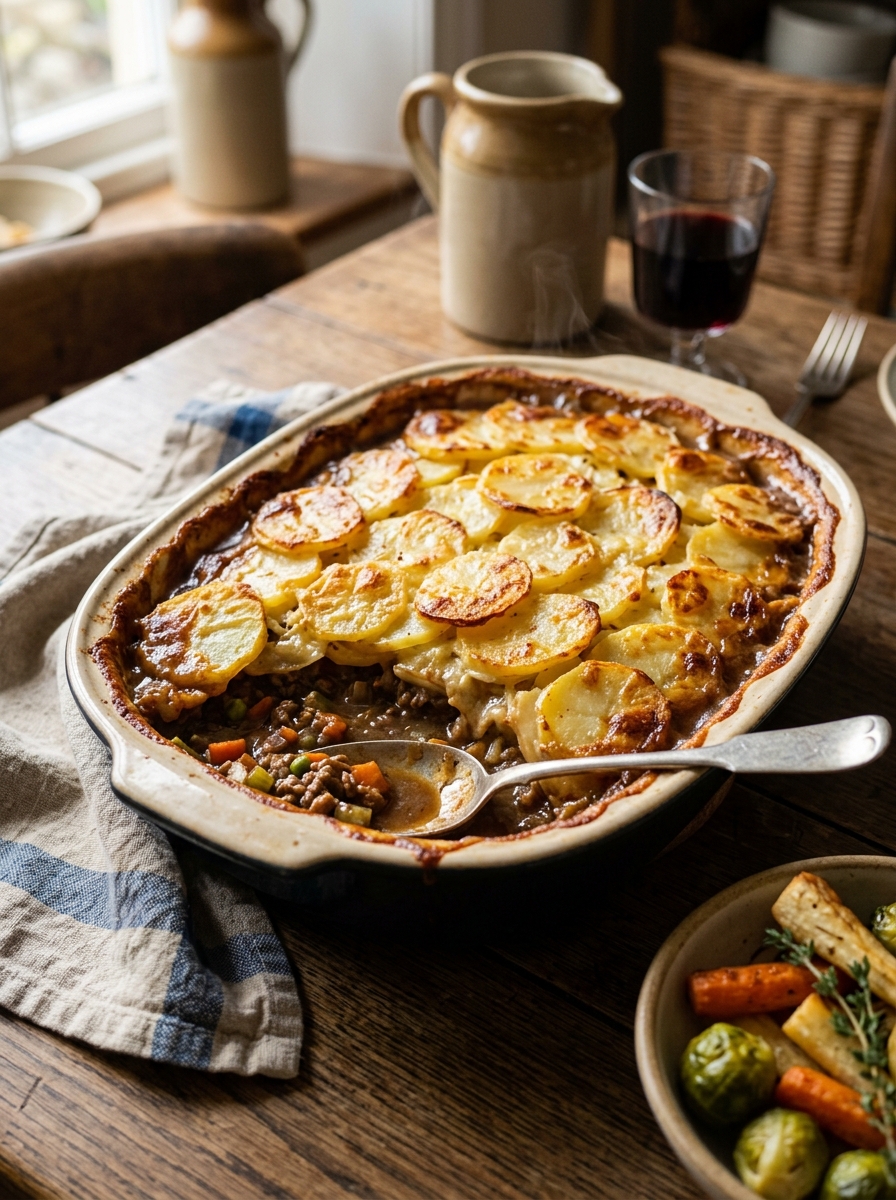
The dauphinoise potato topping changes everything. Instead of a thick, fluffy layer of mash, you get overlapping slices of potato cooked in cream and garlic, golden and slightly crispy on top, soft and yielding underneath, each slice slightly thicker than a crisp but soft enough to cut through easily.
It is more work than a standard cottage pie. Not much more — the dauphinoise topping takes an extra fifteen minutes of preparation. But the result is the most impressive cottage pie I have ever eaten and I make it for every occasion that calls for a genuinely special version of comfort food.
Why Dauphinoise Works So Much Better Than Mash
Mashed potato is the traditional cottage pie topping and it is good — properly made mash, well seasoned and buttery, is a perfectly fine thing on top of a meat filling. But it has two limitations.
First, it absorbs the meat juices from below and can become slightly wet and heavy on the underside. Second, it does not develop much texture contrast — it is soft on top and soft on the bottom, which makes each spoonful fairly uniform.
Dauphinoise has neither problem. The cream in the potato layers keeps each slice distinct and separate. The top layer crisps and browns in the oven to give a genuinely different texture from the creamy layers beneath.
And the garlic cream that soaks through the potatoes and the meat filling below creates a dish where every spoonful has multiple textures and flavours working together.
Ingredients for Mary Berry Cottage Pie with Dauphinoise Potatoes
For the Beef Filling
- 800g beef mince (15–20% fat)
- 2 tbsp sunflower oil
- 2 large onions, finely chopped
- 3 carrots, peeled and finely diced
- 3 celery sticks, finely diced
- 4 garlic cloves, crushed
- 2 tbsp tomato purée
- 2 tbsp plain flour
- 300ml good quality beef stock
- 150ml red wine
- 1 tbsp Worcestershire sauce
- 2 tsp fresh thyme leaves
- 2 bay leaves
- Salt and freshly ground black pepper
For the Dauphinoise Potato Topping
- 1.2kg waxy or all-purpose potatoes (Charlotte or Maris Piper), peeled and very thinly sliced — about 3mm
- 2 garlic cloves, finely sliced
- 400ml double cream
- 200ml whole milk
- 1 tsp fresh thyme leaves
- 50g Gruyère or mature Cheddar, finely grated
- Salt and white pepper
- A little butter for the dish
How to Make Mary Berry Cottage Pie with Dauphinoise Potatoes
Step 1 — Make the Beef Filling
Heat the oil in a large pan over a medium-high heat. Brown the mince in two batches, breaking it up as it cooks, until deeply browned — eight to ten minutes total. Remove and set aside.
In the same pan, cook the onion, carrots, and celery over a medium heat for ten minutes until softened. Add the garlic and thyme and cook for two minutes.
Return the mince. Add the tomato purée — cook one minute. Sprinkle over the flour — stir one minute. Add the wine — bubble and reduce two to three minutes. Add the stock, Worcestershire sauce, and bay leaves. Season generously. Bring to a simmer.
Cook partially covered for 30 to 35 minutes until the sauce is rich, thick, and deeply flavoured. Remove the bay leaves. Taste and season. Transfer to a large, deep ovenproof dish approximately 30x22cm.
Step 2 — Prepare the Dauphinoise Topping
While the filling cooks, combine the double cream, whole milk, sliced garlic, thyme leaves, salt, and white pepper in a large saucepan. Bring to a very gentle simmer over a low heat — stir occasionally and watch it carefully as cream can boil over quickly.
Add the thinly sliced potatoes to the warm cream mixture. Stir gently to separate the slices and coat each one in the cream. Cook for five minutes over a low heat until the potatoes have just started to soften but are not yet cooked through — they will finish in the oven.
Step 3 — Assemble
Preheat your oven to 180°C / 160°C fan / Gas 4.
Using a spoon, carefully layer the cream-coated potato slices over the beef filling in neat overlapping layers. Pour any remaining cream mixture from the pan over the potatoes — this cream will soak through the layers during baking.
Scatter the grated Gruyère or Cheddar over the top.
Step 4 — Bake
Place the dish on a baking tray — the cream can bubble over the sides. Bake for 45 to 55 minutes until the potato topping is completely tender when a knife is inserted through all the layers, the top is deep golden and slightly crispy, and the filling is bubbling around the edges.
If the top is browning too quickly before the potatoes are tender, cover loosely with foil and continue baking.
Leave to rest for ten minutes before serving. The filling needs a moment to settle and the potatoes firm slightly.
My Top Tips For Mary Berry Cottage Pie with Dauphinoise Potatoes
Slice the potatoes thinly and evenly — 3mm. A mandoline makes this quick and completely consistent. Uneven slices cook unevenly — some are done, some are still hard. 3mm is the ideal thickness.
Par-cook the potatoes in cream before layering. Five minutes of gentle cooking in the warm cream starts the cooking process and ensures the potatoes finish in the oven without needing a very long bake time. Without this step, the potatoes can remain slightly underdone when the top is already golden.
The beef filling must be properly seasoned and rich before the potatoes go on. The dauphinoise topping is very creamy and slightly bland — the beef filling beneath needs to be boldly flavoured to balance it. Season the filling more assertively than you would a standard cottage pie.
Use a deep dish. The dauphinoise layers on top of a generously filled cottage pie need depth. A shallow dish overflows and does not give enough space for the potato layers to build up properly.
Rest for ten minutes before serving. The filling is very hot and slightly liquid from the oven. Ten minutes allows it to settle into a scoopable consistency and the potato layers firm slightly.
Serving Suggestions
On its own — this genuinely needs nothing alongside. It is a complete, substantial dinner that requires no accompaniment. With steamed green beans or peas if you want something fresh and green alongside. As the main course for a Sunday lunch that is something genuinely special.
How to Store Mary Berry Cottage Pie with Dauphinoise Potatoes
In the fridge: Store covered for up to 3 days. Reheat covered with foil in a 180°C oven for 25 to 30 minutes until piping hot throughout.
In the freezer: Freeze before baking for up to 2 months. Cover tightly. Defrost overnight in the fridge and bake as directed, adding fifteen minutes to the baking time.
Try These Recipes
- Mary Berry Sweet And Sour Chicken
- Mary Berry Chicken Liver Pate
- Mary Berry Chicken And Ham Pie
- Mary Berry Luxury Fish Pie
Mary Berry Cottage Pie with Dauphinoise Potatoes Recipe
Ingredients
Method
- Brown mince in batches — deeply golden. Remove. Cook onion, carrots, and celery 10 minutes. Add garlic and thyme. Return mince. Add tomato purée — 1 minute. Add flour — 1 minute. Add wine — bubble 2–3 minutes. Add stock, Worcestershire sauce, and bay leaves. Season. Simmer partially covered 30–35 minutes until rich and thick. Remove bay leaves. Transfer to deep ovenproof dish.
- Warm cream, milk, garlic, thyme, salt, and white pepper in a saucepan over low heat. Add sliced potatoes — stir gently to coat. Cook 5 minutes until just beginning to soften.
- Preheat oven to 180°C / 160°C fan / Gas 4. Layer cream-coated potato slices over beef filling in overlapping layers. Pour remaining cream over the top. Scatter with grated cheese.
- Place on a baking tray. Bake 45–55 minutes until potato is completely tender, top is golden, and filling is bubbling. Cover loosely with foil if browning too quickly.
- Rest 10 minutes before serving.
Notes
Frequently Asked Questions
Can I use lamb mince for a shepherd’s pie version with dauphinoise?
Yes — lamb mince with the same method gives a shepherd’s pie with dauphinoise topping that is equally, possibly even more extraordinary. The richness of the lamb and the cream is an exceptional combination.
Can I make the filling the day before?
Yes — and I recommend it. Make the filling, cool completely, and refrigerate overnight. Add the dauphinoise topping fresh on the day and bake. This approach gives the most organised, stress-free version of this dish.
Can I use a mandoline for slicing the potatoes?
Yes — a mandoline is the ideal tool for 3mm potato slices. Use the guard that comes with it — mandoline cuts are the most common serious kitchen injury.
Why are my potatoes still hard after the full baking time?
Either the slices were too thick, the potato variety was too starchy and resistant, or the dish was not covered during the final stage. Cover with foil and give it another fifteen minutes — and check the slice thickness for next time.
Can I add mustard to the cream mixture?
Yes — a teaspoon of Dijon mustard stirred into the cream mixture adds a subtle sharpness that works very well. It does not taste strongly of mustard — it just adds depth.
















Leave a Reply