
 Anna Louise
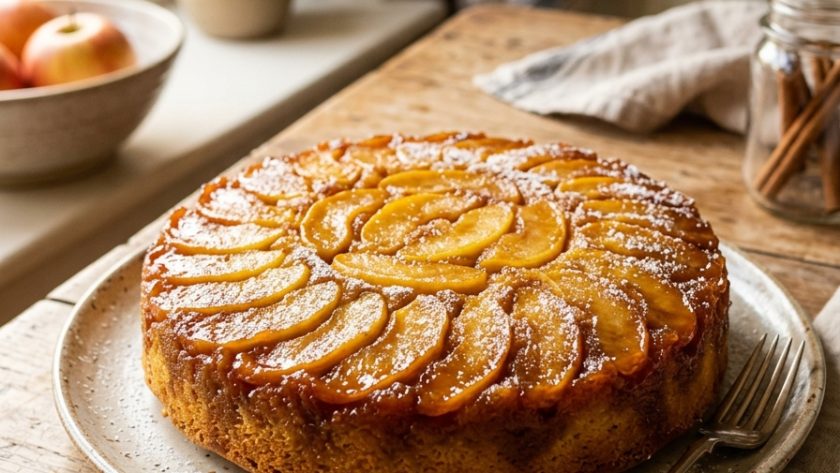
 An upside down cake is one of the most satisfying things you can make — the plain top that goes into the oven becoming a caramelised, jewelled, glossy crown when the tin is inverted. The apple version is particularly beautiful.
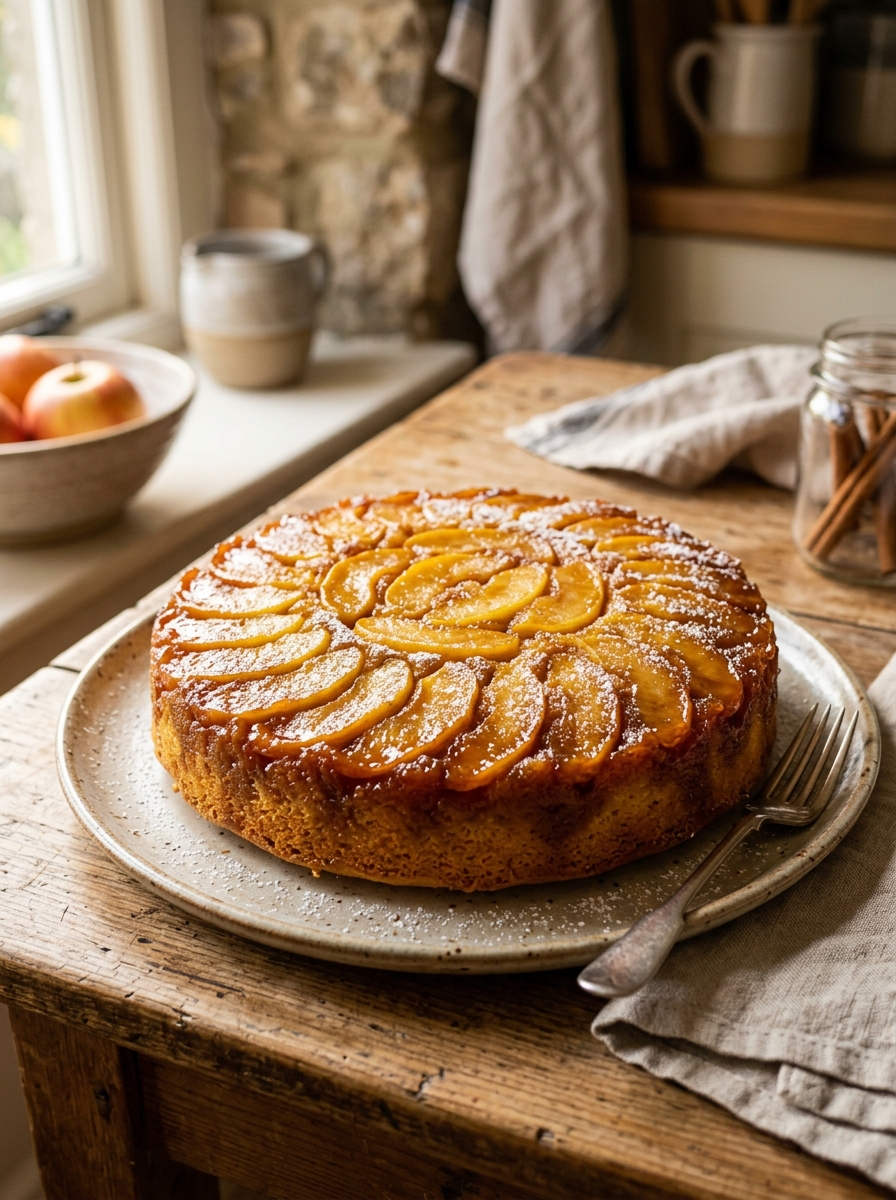
Slices of Braeburn or Cox, arranged in careful circles over a base of brown sugar and butter that caramelises during baking into a deep, glossy toffee, revealed when the warm cake is turned out.
The caramelised apple base is the defining feature — it is not simply fruit on top of a sponge. The butter and brown sugar in the base of the tin cook with the apple juices during baking into something that is genuinely, intensely toffee-like.
Every slice has a golden, sticky, slightly crunchy caramelised surface with deeply flavoured apple embedded throughout it.
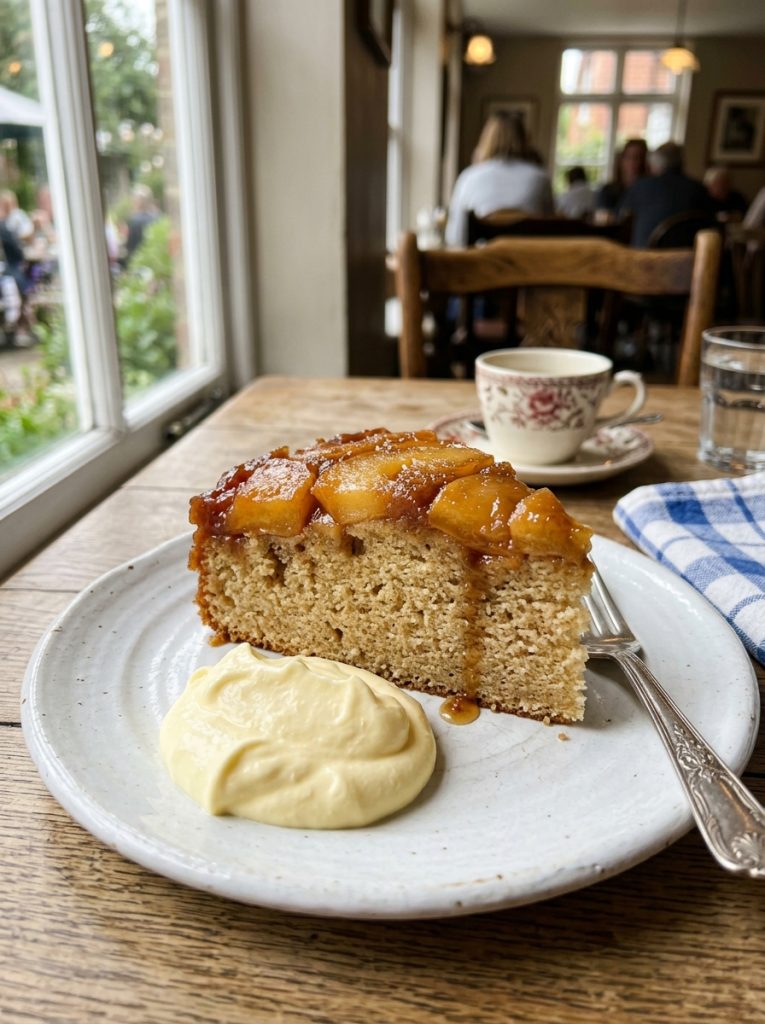
The sponge beneath is a simple, slightly spiced batter that complements rather than competes. The cake is best served warm — just warm enough for the caramel to still be slightly soft and the sponge to still have a trace of heat.
Ingredients for Mary Berry Upside Down Apple Cake
For the Caramelised Apple Topping
- 75g unsalted butter, softened
- 100g soft dark brown sugar
- 3 eating apples — Cox, Braeburn, or Russet — peeled, cored, and sliced into 5mm rounds or half-moons
- ½ tsp ground cinnamon
- Juice of ½ lemon — toss with apple slices immediately after cutting
For the Sponge
- 175g unsalted butter, softened
- 175g golden caster sugar
- 3 large eggs, at room temperature
- 175g self-raising flour, sifted
- 1½ tsp baking powder
- 1 tsp ground cinnamon
- ½ tsp ground ginger
- 2 tbsp whole milk
- 1 tsp vanilla extract
How to Make Mary Berry Upside Down Apple Cake
Step 1 — Prepare the Tin and Caramel Base
Preheat your oven to 180°C / 160°C fan / Gas 4. Line the base of a deep 23cm round cake tin with a circle of baking parchment. Do not use a loose-bottomed tin — the caramel will leak through during baking. A fixed-base tin or a well-sealed springform is essential.
Spread the softened butter over the base of the tin in an even layer. Sprinkle the dark brown sugar evenly over the butter. Scatter the ground cinnamon over the sugar.
Step 2 — Arrange the Apple Slices
Toss the apple slices in the lemon juice immediately after cutting — this prevents browning. Arrange the slices over the butter and sugar in neat, overlapping circles — working from the outside edge inwards to the centre. Press each slice gently into the sugar. The arrangement should cover the entire base of the tin without gaps. It will look significantly more beautiful once inverted — take care at this stage.
Step 3 — Make the Sponge Batter
Beat the softened butter and golden caster sugar together for three to four minutes until pale and fluffy. Add the eggs one at a time, beating well after each. Add the vanilla extract.
Sift the flour, baking powder, cinnamon, and ginger into the bowl. Add the milk. Fold gently until just combined.
Step 4 — Add the Batter Over the Apple
Spoon the sponge batter carefully over the arranged apple slices — do not pour directly as this can disturb the arrangement. Start by dropping small spoonfuls around the edge and working inwards. Spread very gently with the back of a spoon until the entire surface is covered, taking care not to move the apple slices beneath.
The batter layer will be fairly thin — this is correct for an upside down cake.
Step 5 — Bake
Bake for 35 to 40 minutes until the sponge top is golden and a skewer inserted into the centre comes out clean.
Leave to cool in the tin for exactly five minutes — no longer. The caramel is still liquid and the cake will release cleanly. If left too long the caramel begins to set and the cake sticks.
Step 6 — Invert
Place a serving plate or board slightly larger than the tin on top. In one confident movement, invert the tin and plate together. Hold firmly and turn — then lift the tin away carefully. The caramelised apple top is now revealed. Peel away the baking parchment carefully — any apple slices that have shifted can be gently repositioned while the caramel is still warm.
Serve warm.
My Top Tips For Perfect Upside Down Apple Cake
Do not use a loose-bottomed tin. The caramel is liquid during baking and will leak through the gap in a loose-bottomed tin. A fixed-base cake tin or a very tightly wrapped springform is essential.
Invert after exactly five minutes. This is the most time-critical instruction in the recipe. Five minutes allows the cake to firm slightly so it holds its shape during inversion. Less than five minutes and it is too fragile. More than five minutes and the caramel begins to set against the tin and the cake sticks. Set a timer.
Arrange the apples carefully. The arrangement visible after inversion is what the finished cake looks like. Any gaps, any irregular overlapping, and any broken slices will be visible. Spend two minutes arranging neatly — it is worth the time.
Use eating apples not Bramleys. Bramleys collapse completely during baking. Eating apples hold their shape — slightly softened, slightly caramelised at the edges, but still identifiable and beautiful after inversion.
Serve warm. The caramel is at its most glossy and most flavourful when the cake is still slightly warm. Cold caramel sets to something harder and less appealing. Warm is the right moment.
Serving Suggestions
With a generous spoonful of clotted cream alongside — the cream melts slightly into the warm caramel and is completely wonderful. With vanilla ice cream.
With crème fraîche for something slightly sharper. As a pudding at a dinner party — it looks spectacular and can be made and inverted an hour ahead of serving and kept warm.
How to Store
At room temperature: Store covered for up to 3 days. Warm briefly in a low oven for ten minutes before serving — the caramel softens again beautifully.
In the freezer: Freeze in slices for up to 3 months. Defrost at room temperature and warm in a 150°C oven for ten minutes before serving.
Try These Recipes
- Mary Berry Dutch Apple Cake
- Mary Berry Baileys Cheesecake
- Mary Berry Lemon Victoria Sponge
- Mary Berry Carrot Cake Cupcakes
Mary Berry Upside Down Apple Cake Recipe
Ingredients
Method
- Preheat oven to 180°C / 160°C fan / Gas 4. Line base of a deep 23cm fixed-base tin with parchment. Spread butter over base — sprinkle brown sugar and cinnamon evenly.
- Toss apple slices in lemon juice immediately. Arrange in overlapping circles over the butter and sugar — press gently. Cover the entire base neatly.
- Beat butter and caster sugar 3–4 minutes until pale and fluffy. Add eggs one at a time. Add vanilla. Sift in flour, baking powder, cinnamon, and ginger. Add milk — fold gently.
- Drop small spoonfuls of batter over the apple arrangement — work from the edges inwards. Spread very gently to cover completely without disturbing the apples.
- Bake 35–40 minutes until sponge top is golden and skewer comes out clean.
- Cool in tin exactly 5 minutes — set a timer. Place serving plate on top — invert confidently in one movement. Lift tin. Peel away parchment. Reposition any shifted slices while caramel is warm. Serve warm.
Notes
Frequently Asked Questions
Can I use pears instead of apples?
Yes — ripe but firm pears give an elegant, slightly more delicate result. Use Conference or Comice — they hold their shape well during baking and look beautiful when inverted.
Can I add walnuts to the caramel base?
Yes — scatter 50g of roughly chopped walnuts over the butter and sugar before arranging the apple slices. They caramelise with the sugar and give a pleasant crunch in the finished cake.
Can I add a layer of marzipan between the apple and the sponge?
Yes — a thin layer of marzipan pressed over the arranged apple slices before the sponge batter gives an almond-apple combination that is completely wonderful. Use about 100g of marzipan rolled thin.
My caramel top has some uneven spots after inversion — what happened?
Some apple slices shifted during baking or during inversion. Reposition them with a palette knife while the caramel is still warm — it sets soft and repositioning is straightforward within the first few minutes after inversion.
Can I make this in a traybake tin?
Yes — a 23x30cm traybake tin gives a shallower cake that cuts into squares. Reduce the baking time to 25 to 30 minutes.















Leave a Reply