
 Anna Louise
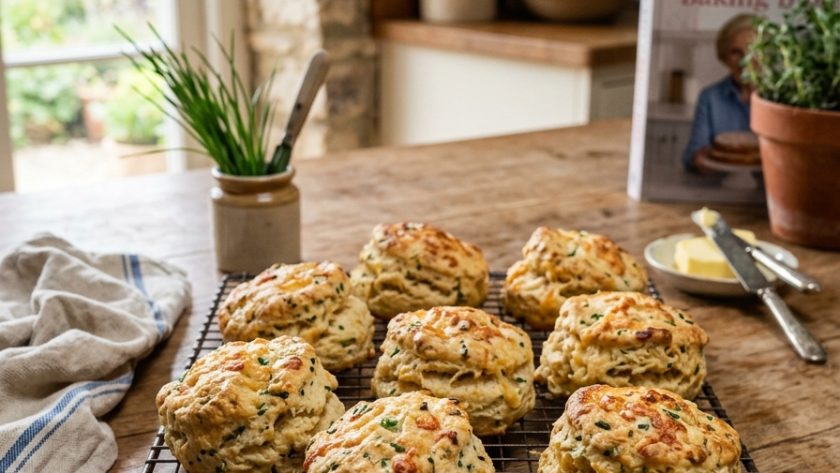
 The cheese scone is the savoury counterpart to the cream tea scone — equally beloved, equally simple, and equally dependent on the same technique for the same dramatic rise and tender crumb.
The addition of fresh chives gives a mild, oniony freshness that suits the sharp mature Cheddar beautifully and makes these considerably more interesting than a plain cheese scone.
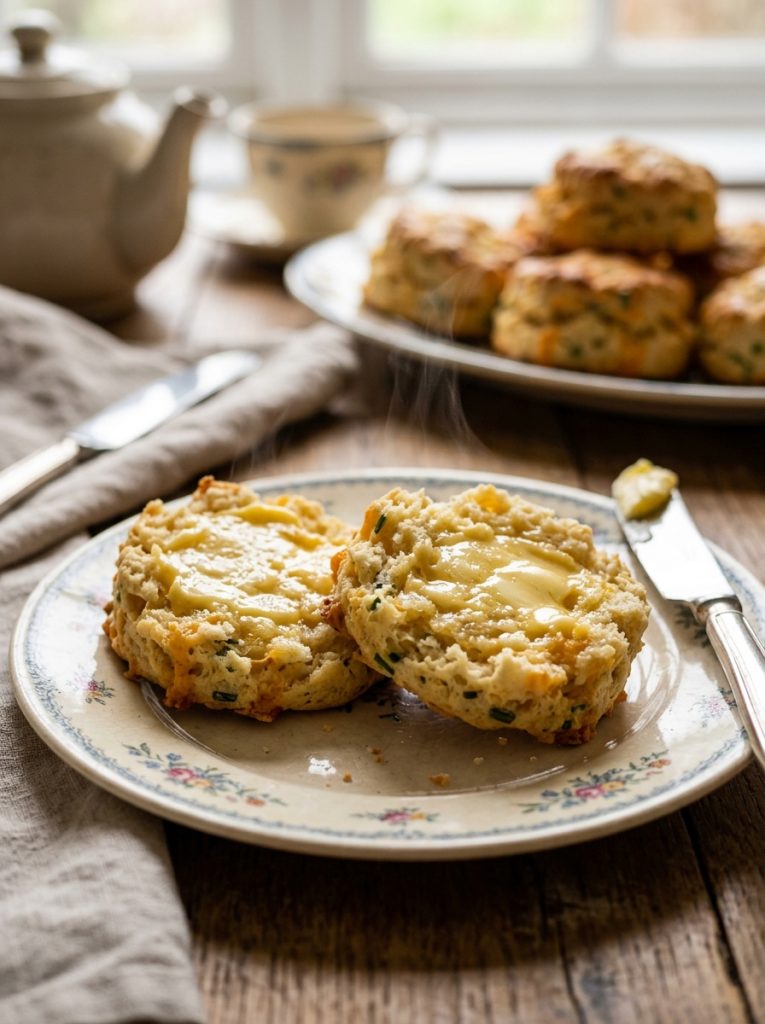
These are the scones I make when soup is for lunch — split warm from the oven and spread with cold salted butter, they are one of the finest things in the British baking repertoire.
They are also the scones I make for a cheese board, for a picnic, or for any occasion where a savoury bake is more appropriate than a sweet one.
The technique is identical to every other scone recipe on this site — cold butter, minimal working, a very hot oven. The cold Cheddar must be coarsely grated and mixed through the crumb rather than added to the liquid — it distributes more evenly through the dough this way and gives pockets of melted cheese throughout every scone.
Ingredients for Mary Berry Cheese and Chive Scones
For the Scones (Makes about 10–12)
- 450g self-raising flour, sifted — plus extra for dusting
- 2 tsp baking powder
- 1 tsp mustard powder
- ½ tsp fine salt
- ½ tsp cayenne pepper — gives warmth without heat
- 100g unsalted butter, cold and cut into small cubes
- 175g mature Cheddar, coarsely grated — plus extra for the tops
- 3 tbsp fresh chives, finely snipped
- 2 large eggs, beaten
- 150ml whole milk — plus a little extra for brushing
How to Make Mary Berry Cheese and Chive Scones
Step 1 — Preheat and Prepare
Preheat your oven to 220°C / 200°C fan / Gas 7. Line a large baking tray with baking parchment.
Step 2 — Rub In the Butter
Sift the flour, baking powder, mustard powder, salt, and cayenne into a large bowl. Add the cold cubed butter.
Rub the butter into the flour quickly and lightly with fingertips — lifting and rubbing — until the mixture resembles fine breadcrumbs with a few pea-sized pieces of butter still visible. Work quickly. If your hands feel warm at any point, refrigerate the bowl for five minutes before continuing.
Step 3 — Add the Cheese and Chives
Add 150g of the grated Cheddar and all the snipped chives to the crumb mixture. Toss with a fork to distribute evenly throughout.
Step 4 — Add the Liquid
Beat the eggs lightly in a small jug. Add the milk and stir together. Reserve two tablespoons for brushing.
Make a well in the centre of the flour and cheese mixture. Pour in almost all the egg and milk. Mix quickly with a round-bladed knife in short cutting strokes until a soft, slightly sticky dough just comes together. Add the remaining liquid only if the dough seems dry.
Do not overwork. Stop the moment the dough coheres.
Step 5 — Pat and Cut
Turn the dough out onto a lightly floured surface. Pat gently — not roll — to a thickness of 3cm. The flat palm, pressing gently, gives a more tender crumb than a rolling pin.
Dip a 6cm round straight-sided cutter in flour. Press straight down and lift straight up — never twist. Place on the prepared tray with a little space between each. Gather the trimmings gently once, pat together, and cut again.
Step 6 — Glaze and Bake
Brush the tops of the scones very lightly with the reserved egg and milk — tops only, never the sides. Scatter the reserved 25g of grated Cheddar over each top — a generous pinch per scone.
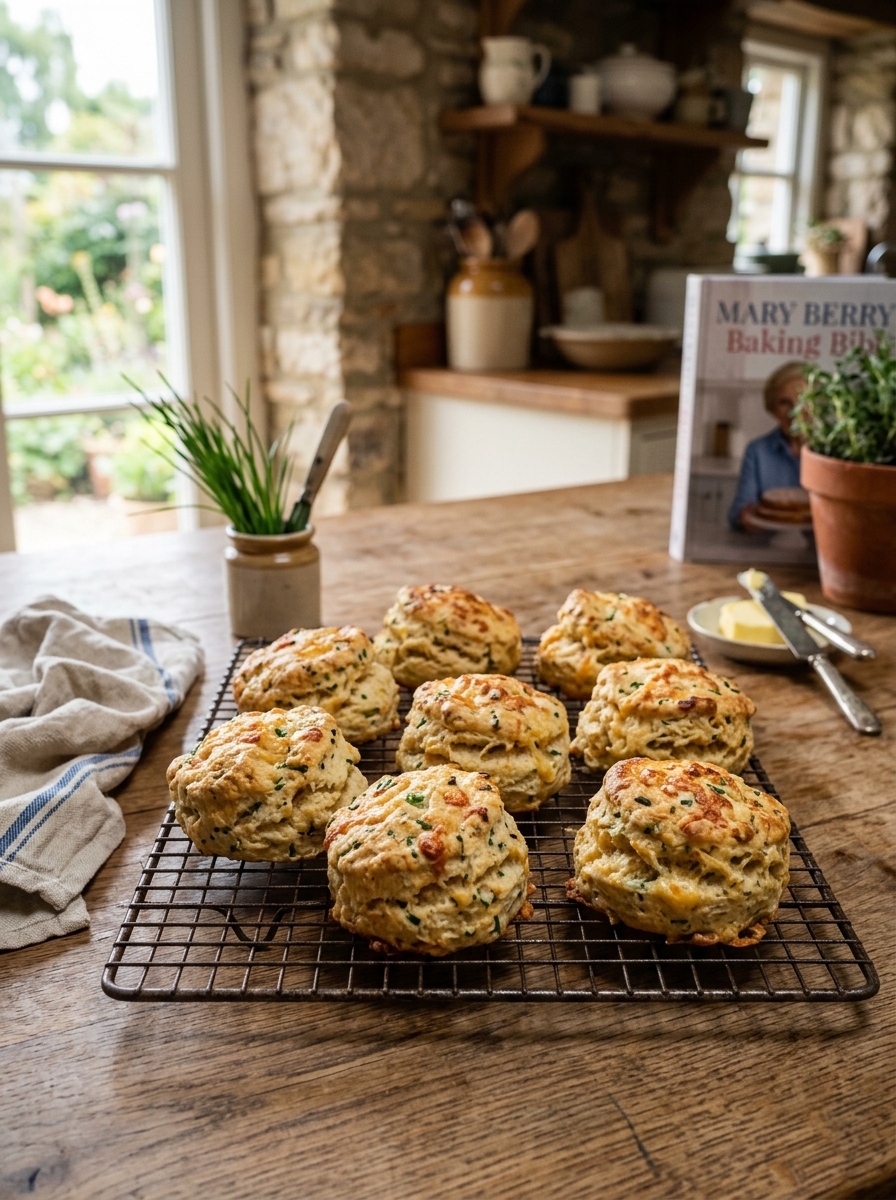
Bake for 12 to 14 minutes until well risen, deep golden on top from both the egg wash and the melted Cheddar, and firm to a gentle press.
Transfer to a wire rack. Serve warm — ideally within thirty minutes of baking.
My Top Tips For Perfect Cheese and Chive Scones
Use mature Cheddar — not mild. Mild Cheddar gives a pleasant but flat cheese flavour in a scone. Mature Cheddar gives the sharp, assertive character that makes a cheese scone taste properly cheesy. Extra mature gives an even more pronounced result. The cheese is the primary flavour — use the strongest you have.
Coarsely grate the Cheddar. Finely grated Cheddar disappears into the dough and distributes flavour without giving distinct pockets of melted cheese. Coarsely grated Cheddar stays in identifiable pieces that melt into small pools during baking — giving the characteristic buttery, cheesy pockets throughout every scone.
The mustard powder and cayenne are essential. Both are invisible in the finished scone — neither makes the scone taste of mustard or chilli. Together they give a background warmth and complexity that makes the cheese flavour seem more pronounced and more interesting.
Snip chives with scissors rather than chopping. Scissors give clean, even cuts without bruising the chives. Bruised chives release their juice into the surrounding dough and can give a slightly bitter note. Scissors — clean snips — give the freshest chive flavour.
Scatter Cheddar on top before baking. The extra Cheddar on top melts and caramelises during baking, giving a particularly golden, particularly savoury top crust with slightly crispy caramelised cheese at the edges of each scone. Do not skip this.
Serving Suggestions
Split and spread with cold salted butter — with soup or on their own. On a cheese board alongside a selection of British cheeses. At a picnic — they travel well and eat beautifully cold. As part of an afternoon tea where savoury is wanted alongside the sweet.
How to Store Cheese and Chive Scones
At room temperature: Best eaten within two hours of baking. Store in an airtight container for up to 2 days — refresh in a 170°C oven for five minutes.
In the freezer: Freeze raw cut scones on a tray until solid, then transfer to a bag for up to 3 months. Bake from frozen at 220°C for 16 to 18 minutes.
Try These Recipes
- Mary Berry Sultana Scones
- Mary Berry Simple Pancake Mixture
- Mary Berry Drop Scones Pancakes
- Mary Berry 2 Egg Yorkshire Pudding
Mary Berry Cheese and Chive Scones Recipe
Ingredients
Method
- Preheat oven to 220°C / 200°C fan / Gas 7. Line a large tray with parchment.
- Sift flour, baking powder, mustard powder, salt, and cayenne. Rub in cold butter until fine breadcrumbs with a few pea-sized pieces. Add 150g Cheddar and chives — toss to distribute.
- Beat eggs and milk — reserve 2 tbsp. Make a well — add almost all liquid. Mix with a round-bladed knife until just combined. Do not overwork.
- Pat gently on lightly floured surface to exactly 3cm. Dip 6cm cutter in flour — press straight down, never twist. Gather once — pat and cut again.
- Place on tray. Brush tops only with reserved egg and milk. Scatter reserved 25g Cheddar over each top generously.
- Bake 12–14 minutes until well risen, deeply golden, and firm. Serve warm within 30 minutes.
Notes
Frequently Asked Questions
Can I use Gruyère instead of Cheddar?
Yes — Gruyère gives a more complex, nuttier flavour and melts particularly beautifully. It is slightly less sharp than mature Cheddar — use 200g to compensate for the milder flavour.
Can I add sun-dried tomatoes?
Yes — 50g of sun-dried tomatoes in oil, drained and finely chopped, add a rich, slightly sweet note that works very well alongside the Cheddar and chives.
Can I use spring onions instead of chives?
Yes — finely sliced spring onions give a slightly more pronounced onion flavour. Chives give a more delicate, more specifically chive character. Both are good.
Why are my cheese scones not rising?
The most common causes are baking powder past its use-by date, dough patted too thin, cutter twisted rather than pressed, or oven not hot enough. All four are equally important.
Can I add bacon?
Yes — 100g of smoked bacon lardons, cooked until golden and cooled, added with the Cheddar and chives give a deeply savoury, smoky note that is completely wonderful.














Leave a Reply