

 Anna Louise
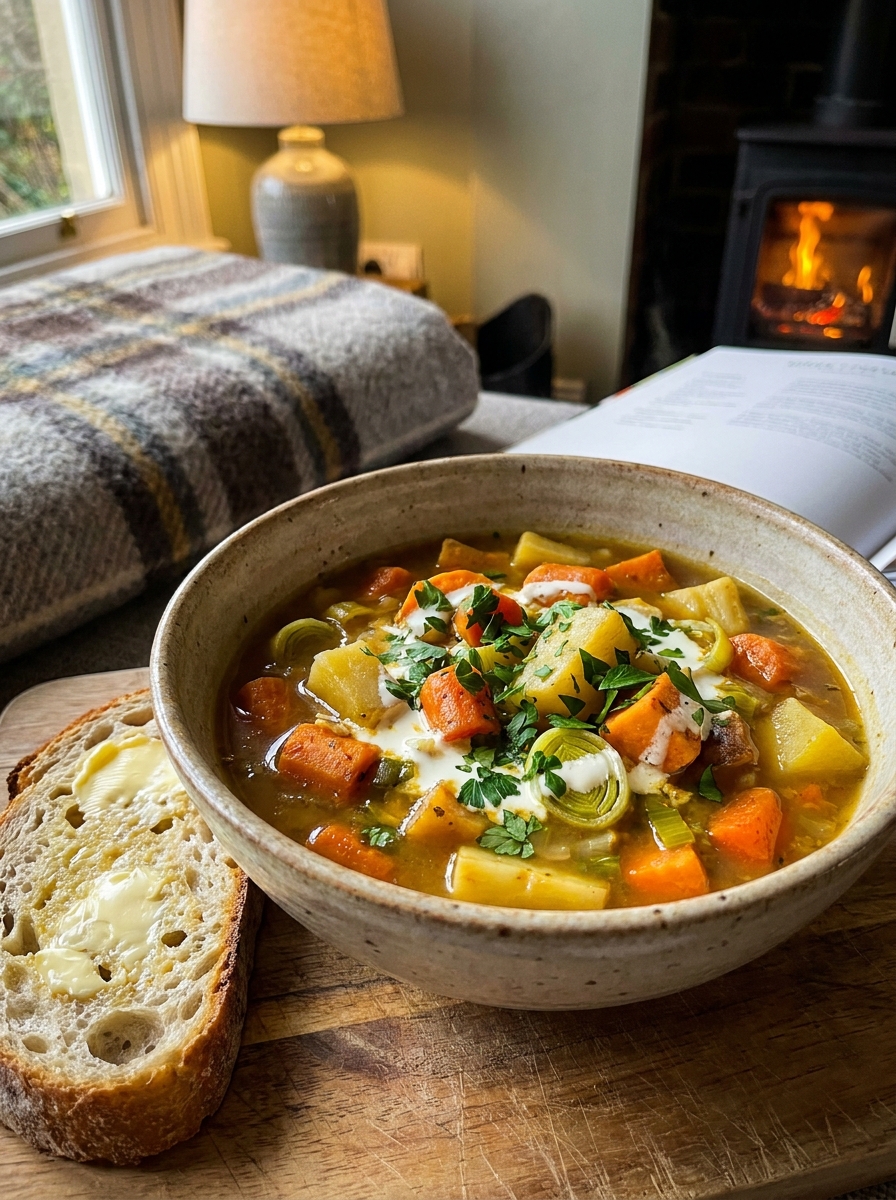
This is the soup I make more than any other throughout the autumn and winter months. It is not a single-vegetable soup — not a pure carrot or a pure parsnip — but a generous, chunky, deeply flavoured combination of whatever root vegetables I have: carrots, parsnips, swede, sweet potato, leek, and celery.
Roasted first until slightly caramelised, then simmered in a good vegetable stock, they give a soup with a depth and sweetness that a quickly boiled vegetable soup does not quite achieve.
I always roast at least some of the vegetables before adding them to the stock. The roasting step is optional in the sense that you can skip it and still make a good soup — but when I do it, the soup is noticeably more complex in flavour.
The caramelised edges of the vegetables add a sweetness and a slight nuttiness that goes straight into the stock.

Ingredients for Mary Berry Winter Vegetable Soup
For the Soup
- 3 tbsp olive oil
- 2 large carrots, peeled and cut into 2cm chunks
- 2 parsnips, peeled and cut into 2cm chunks
- 200g swede, peeled and cut into 2cm chunks
- 1 large sweet potato, peeled and cut into 2cm chunks
- 2 celery sticks, sliced into 1cm pieces
- 2 large leeks, trimmed, cleaned, and sliced into 1cm rounds
- 1 large onion, roughly chopped
- 4 garlic cloves, crushed
- 1.5 litres good quality vegetable stock — hot
- 1 tsp dried thyme
- 1 bay leaf
- Salt and freshly ground black pepper
To Finish
- 2 tbsp fresh flat-leaf parsley, chopped — stirred through at the end
- A swirl of single cream or crème fraîche — optional but very good
- Crusty bread for serving alongside
How to Make Mary Berry Winter Vegetable Soup
Step 1 — Roast the Root Vegetables
Preheat your oven to 200°C / 180°C fan / Gas 6. Spread the carrot, parsnip, swede, and sweet potato chunks on a large roasting tray. Drizzle with two tablespoons of the olive oil. Season generously. Toss to coat.
Roast for 25 to 30 minutes until the vegetables are golden at the edges and slightly caramelised — turning once halfway through. They do not need to be completely cooked through — they will finish cooking in the stock.
Step 2 — Cook the Aromatics
While the vegetables are roasting, heat the remaining tablespoon of oil in a large saucepan over a medium heat. Add the chopped onion. Cook for eight minutes until soft and slightly golden. Add the leeks and celery — cook for five more minutes. Add the garlic and dried thyme — cook for two minutes.
Step 3 — Build the Soup
Add the roasted vegetables to the saucepan. Add the hot vegetable stock and bay leaf. Season generously. Bring to a gentle simmer. Cook for 20 to 25 minutes until every vegetable is completely tender.
Step 4 — Decide on Texture
At this point I decide how chunky I want the soup. I usually use a potato masher to roughly mash about a third of the vegetables directly in the pot — giving a soup that is partly thick and creamy and partly chunky. This is my favourite texture for a winter vegetable soup.
Alternatively — blend completely smooth with a stick blender for a velvety soup, or leave completely chunky for a more stew-like result.
Step 5 — Finish and Serve
Remove the bay leaf. Stir in the fresh parsley. Taste and season very assertively — a vegetable soup needs confident seasoning to taste properly flavoured rather than simply warm and wet.
Serve in deep bowls with a swirl of cream or crème fraîche if using, and crusty bread alongside.
My Top Tips For Perfect Mary Berry Winter Vegetable Soup
Roast the root vegetables before adding to the stock. I have made this soup both ways — roasted vegetables and directly boiled — and the roasted version is noticeably better. The twenty-five minutes of roasting gives caramelised edges and a sweetness that transforms the finished soup. It is well worth the extra step.
Use a hot stock — not cold. Adding hot stock to the softened aromatics and roasted vegetables gives a soup that comes to temperature quickly and starts cooking the vegetables immediately. Cold stock from the fridge adds unnecessary time and cools everything down.
Mash roughly for the best texture. I find that a completely smooth winter vegetable soup feels slightly less satisfying than one that has some texture. Roughly mashing about a third of the vegetables with a potato masher gives the best of both — thickened, creamy body with chunky pieces visible throughout.
Season assertively at the end. Vegetable soup is the category of soup that most often comes out under-seasoned. Vegetables need more salt than most cooks expect. Taste the soup before serving and add salt until it tastes properly flavoured — not just warm.
Make a big batch — it freezes perfectly. This soup freezes beautifully and reheats without any loss of quality. I almost always make double the quantity and freeze half in portions.
Serving Suggestions
In deep bowls with crusty bread — the soup is hearty enough to be a complete meal. With a swirl of cream or crème fraîche and a scattering of fresh parsley. As a warming weekday lunch. As a starter before a Sunday roast.
How to Store Mary Berry Winter Vegetable Soup
In the fridge: Store covered for up to 4 days. Reheat gently in a saucepan, stirring occasionally — add a splash of stock if the soup has thickened too much. In the freezer: Freeze in portions for up to 3 months. Defrost overnight and reheat gently.
Mary Berry Winter Vegetable Soup Recipe
Ingredients
Method
- Preheat oven to 200°C / 180°C fan / Gas 6. Spread carrot, parsnip, swede, and sweet potato on a large tray — drizzle with 2 tbsp oil, season, toss. Roast 25–30 minutes until golden at edges, turning once.
- Heat remaining 1 tbsp oil in a large saucepan. Cook onion 8 minutes. Add leeks and celery — 5 minutes. Add garlic and thyme — 2 minutes.
- Add roasted vegetables to pan. Pour in hot stock. Add bay leaf — season. Simmer gently 20–25 minutes until all vegetables completely tender.
- Remove bay leaf. Roughly mash about one-third of the vegetables with a potato masher for a partly thick, partly chunky texture. Or blend smooth. Or leave chunky.
- Stir in fresh parsley. Taste — season very assertively. Serve in deep bowls with cream swirl if using and crusty bread.
Notes
Frequently Asked Questions
Can I use other vegetables?
Yes — turnip, celeriac, butternut squash, and potato all work well in this soup. Use whatever root vegetables you have. The total weight of vegetables should stay roughly the same.
Can I add lentils for extra substance?
Yes — 100g of red lentils added with the stock give additional body, protein, and a slightly creamier texture. They dissolve almost completely during cooking and thicken the soup naturally.
Can I make this creamy?
Yes — stir 100ml of double cream or crème fraîche into the blended soup just before serving for a richer, creamier result.
Can I leave out the roasting step?
Yes — add all the vegetables raw to the softened onion and leek, cover with hot stock, and simmer for 30 to 35 minutes until completely tender. The soup is still very good — just slightly less complex in flavour.














Leave a Reply