
 Anna Louise
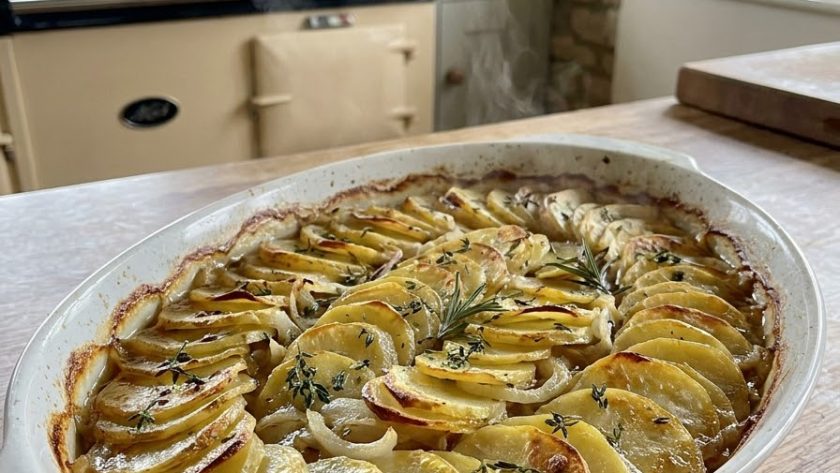
 Boulangere potatoes are the potato dish I make when I want the elegance of dauphinoise without the richness — or when I am serving a particularly rich main course and want the potato side to complement rather than compete with it.
The name comes from the French boulanger — the baker — because the dish was traditionally taken to the local bakery oven after the bread had been baked, cooked slowly in the residual heat.
The technique is similar to dauphinoise: thinly sliced potatoes layered in a dish, cooked slowly until completely tender. The crucial difference is that boulangere uses stock — beef, chicken, or vegetable — rather than cream.
The stock soaks into the potato layers during cooking, giving a silky, tender result with a deeply savoury flavour, a golden top layer, and a much lighter dish than the cream-enriched dauphinoise.
The onions and thyme layered between the potato slices give a fragrant, slightly sweet base note that makes the whole dish more interesting than plain baked potatoes.
The top layer — pressed flat, brushed with butter, and baked until golden and slightly crispy — is the most beautiful aspect of boulangere potatoes and the reason I prefer them to dauphinoise for certain meals.
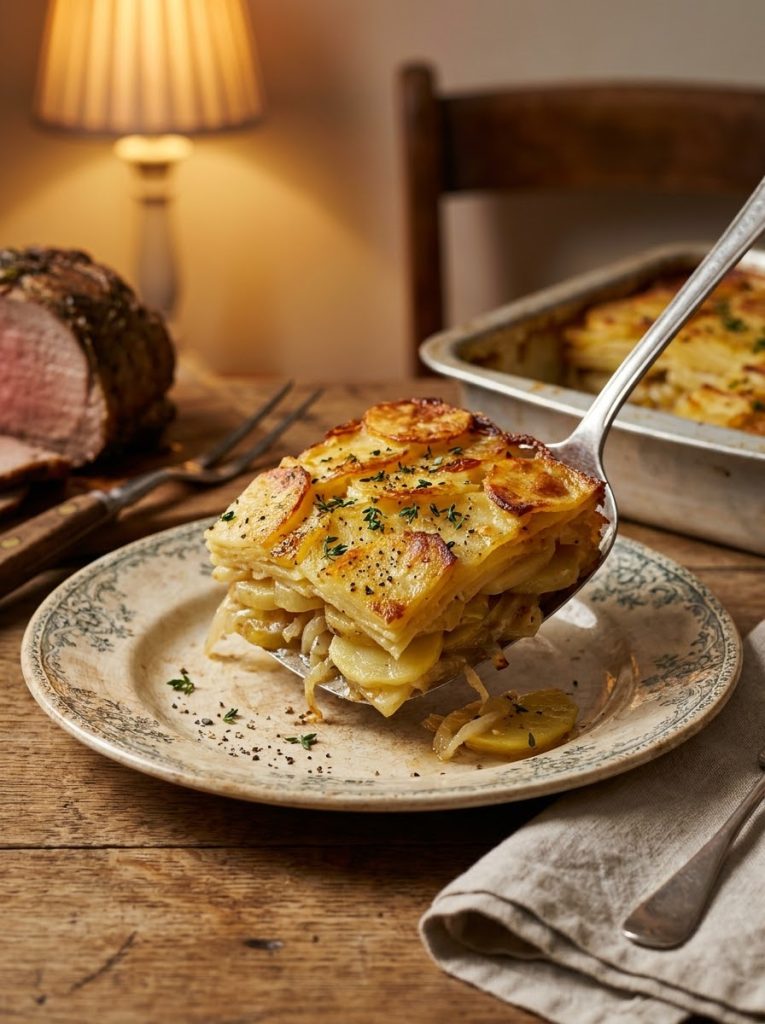
Ingredients for Mary Berry Boulangere Potatoes
For the Boulangere Potatoes
- 1.2kg waxy potatoes — Charlotte or Désirée, peeled and sliced very thinly (2–3mm)
- 2 large onions, halved and very thinly sliced
- 3 garlic cloves, crushed
- 500ml good quality beef or chicken stock — hot
- 30g unsalted butter — melted, for brushing the top layer and greasing the dish
- 1 tbsp fresh thyme leaves — plus extra sprigs for the top
- Salt and freshly ground black pepper
How to Make Mary Berry Boulangere Potatoes
Step 1 — Preheat and Prepare
Preheat your oven to 180°C / 160°C fan / Gas 4. Grease a deep 30x20cm ovenproof dish generously with some of the melted butter.
Slice the potatoes very thinly — 2 to 3mm. A mandoline gives the most consistent, most precise slices and is the right tool for this dish. Consistent slicing gives even cooking throughout. Inconsistent slicing gives some layers overcooked and some underdone.
Step 2 — Layer the Potatoes and Onions
Arrange a layer of potato slices over the base of the dish — overlapping slightly. Scatter a layer of thinly sliced onion over the potatoes. Season with salt, pepper, a scattering of thyme leaves, and a small amount of the crushed garlic. Repeat the layers — potato, onion, seasoning, thyme — until all the potatoes and onions are used, finishing with a neat, overlapping layer of potato slices on top.
Press the layers down firmly with the palms of your hands — compacting the layers so the dish is as densely packed as possible. This gives a more defined, more beautiful finished dish.
Step 3 — Add the Stock
Pour the hot stock slowly and evenly over the potato layers — the stock should come to just below the top layer of potatoes. If the stock does not reach the right level, add a little more. The top layer of potatoes should be just above the stock level so it browns and crisps during baking rather than steaming.
Brush the top layer generously with the remaining melted butter. Lay a few fresh thyme sprigs over the top.
Step 4 — Bake
Cover tightly with foil. Bake for 45 minutes.
Remove the foil. Brush the top layer with any butter that has pooled in the corners of the dish. Return to the oven uncovered for 30 to 40 minutes until the top layer is deeply golden, slightly crispy, and a sharp knife pressed through the centre meets no resistance — the potatoes are completely tender throughout.
Leave to rest for ten minutes before serving — the layers firm slightly and the dish cuts into portions more cleanly.
My Top Tips For Perfect Mary Berry Boulangere Potatoes
Slice the potatoes to exactly 2–3mm — use a mandoline. The consistent thin slicing is what gives boulangere potatoes their characteristic silky texture and even cooking. Thicker slices give an uneven result — some overcooked, some underdone. The mandoline takes two minutes to set up and gives perfect results every time.
Use hot stock — not cold. Cold stock added to raw potato layers requires the oven to heat the stock from room temperature before the cooking of the potatoes can begin. Hot stock poured over the layers immediately begins cooking the potato from the moment it goes in the oven, reducing the total cooking time and giving more even results.
Keep the top layer of potatoes just above the stock level. The top layer must be slightly exposed — above the liquid — to brown and crisp in the oven heat. If the stock covers the top layer, the entire dish steams and the characteristic golden, slightly crispy top is lost.
Press the layers down firmly. Loosely stacked potato layers give an unstable dish that falls apart when served. Firmly pressed layers give a cohesive, defined dish that cuts into portions that hold their shape on the plate.
Make it ahead and reheat. Boulangere potatoes made the day before and reheated at 180°C for twenty to twenty-five minutes are arguably better than freshly made — the layers have compressed and the flavours have integrated. It is one of the most convenient potato dishes for entertaining.
Serving Suggestions
Alongside roast lamb — the most traditionally correct pairing. Alongside roast chicken. Alongside beef bourguignon or any rich braise where a lighter potato side dish is preferable to dauphinoise. As a vegetarian main course with a simple green salad alongside.
How to Store Mary Berry Boulangere Potatoes
In the fridge: Store covered for up to 3 days. Reheat at 180°C for 20 to 25 minutes — covering with foil for the first fifteen minutes and removing for the final ten to re-crisp the top.
In the freezer: Freeze in portions for up to 2 months. Defrost overnight and reheat as directed.
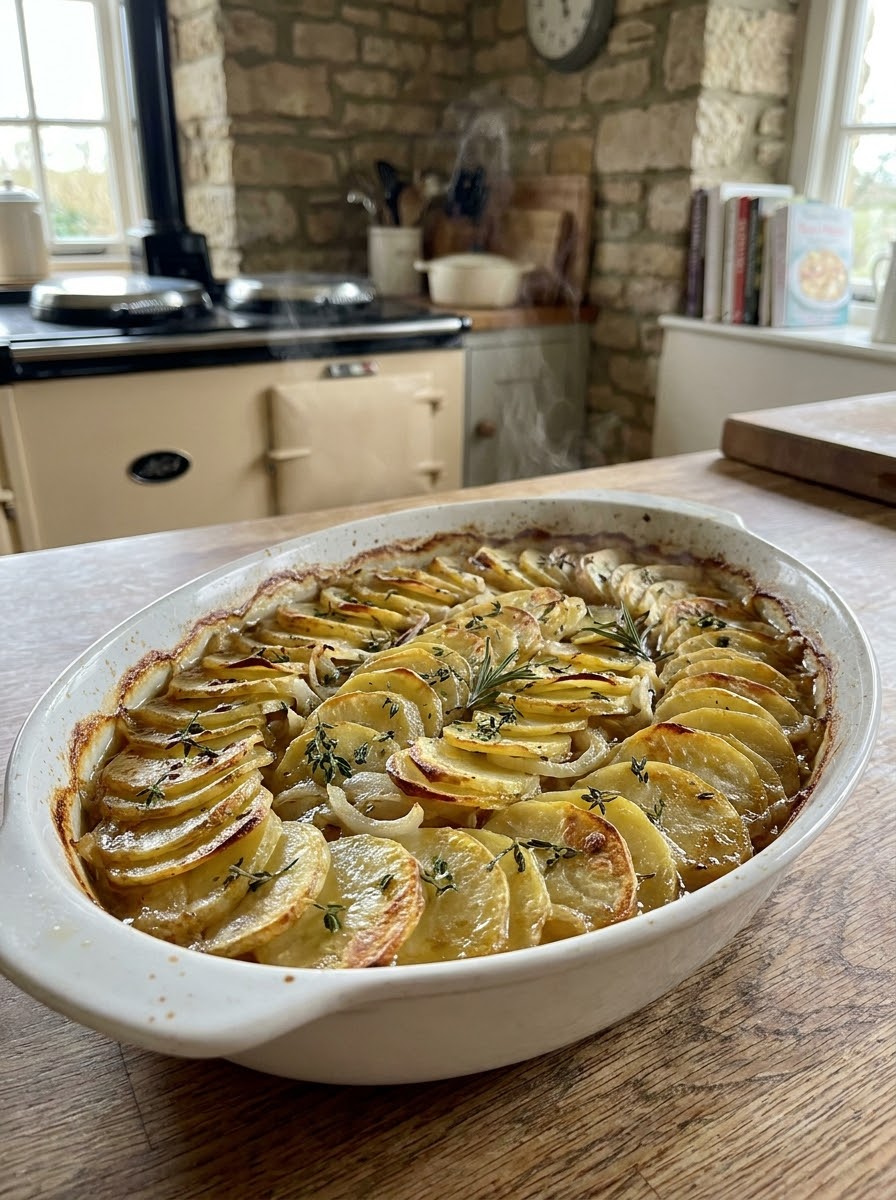
Mary Berry Boulangere Potatoes Recipe
Ingredients
Method
- Preheat oven to 180°C / 160°C fan / Gas 4. Butter a deep 30x20cm ovenproof dish generously.
- Slice potatoes to 2–3mm — use a mandoline for consistency.
- Layer potato slices over base — slightly overlapping. Scatter onion, seasoning, thyme, and garlic. Repeat until all used — finish with neat potato layer on top. Press down firmly.
- Pour hot stock slowly over layers — to just below the top potato layer. Brush top generously with melted butter. Lay thyme sprigs over.
- Cover tightly with foil — bake 45 minutes. Remove foil — brush top with any pooled butter. Bake uncovered 30–40 minutes until top is deeply golden and crispy and a knife slides through without resistance.
- Rest 10 minutes. Cut into portions and serve.
Notes
Frequently Asked Questions
What is the difference between boulangere and dauphinoise?
Dauphinoise uses cream and sometimes cheese — it is rich, indulgent, and deeply satisfying. Boulangere uses stock — it is lighter, more savoury, and more elegant. Both are wonderful but they suit different occasions and different main courses.
Can I use vegetable stock?
Yes — vegetable stock gives a lighter, slightly more neutral flavour. Beef stock gives the deepest flavour. Chicken stock gives a good middle ground that suits both meat and vegetarian occasions.
Can I add Gruyère to the top?
Yes — 50g of grated Gruyère scattered over the top layer for the final fifteen minutes of baking gives a slightly cheesy, slightly more indulgent result. This bridges the gap between boulangere and dauphinoise.
Can I use floury potatoes?
Waxy potatoes — Charlotte or Désirée — give the cleanest, most defined layers. Floury potatoes tend to break down slightly more, giving a slightly less defined result. Both are good but waxy is preferred.
















Leave a Reply