
 Anna Louise
 Profiteroles are the dinner party dessert that people tend to associate with effort and expertise — and that turns out, when you understand the technique, to be completely achievable in a home kitchen.
The choux pastry is the part that seems intimidating and is actually straightforward once you understand what you are doing and why.
Choux is not like any other pastry. It is made on the hob — butter and water brought to the boil, flour beaten in all at once, eggs beaten in one at a time — giving a paste that is glossy, smooth, and quite unlike any other dough.
The steam created by the water and eggs trapped inside the pastry during baking is what causes the dramatic rise and the characteristic hollow centre that the cream filling perfectly occupies.
I make these for dinner parties when I want something that looks genuinely impressive, tastes completely wonderful, and that I have prepared ahead in stages. The choux buns bake and cool.
The chocolate sauce is made. Everything is assembled at the last moment — cream piped in, chocolate drizzled over — and brought to the table looking completely spectacular.
Ingredients for Mary Berry Profiteroles
For the Choux Pastry (Makes 24–28 profiteroles)
- 150ml cold water
- 60g unsalted butter, cut into small cubes
- 75g plain flour, sifted — all at once before you start, into a sheet of baking parchment
- 2 large eggs, beaten — at room temperature
For the Cream Filling
- 400ml double cream, cold
- 2 tbsp icing sugar
- 1 tsp vanilla extract
For the Dark Chocolate Sauce
- 200g good quality dark chocolate (70%), finely chopped
- 200ml double cream
- 2 tbsp golden syrup
- 1 tsp vanilla extract
How to Make Mary Berry Profiteroles
Step 1 — Make the Choux Pastry
Preheat your oven to 200°C / 180°C fan / Gas 6. Line two large baking trays with baking parchment.
Place the water and butter cubes in a medium saucepan. Heat over a medium heat, stirring occasionally, until the butter has completely melted. Increase the heat and bring to a vigorous boil — the moment it reaches a full rolling boil, remove from the heat immediately.
Tip all the sifted flour in at once. Beat vigorously with a wooden spoon — the mixture will come together into a smooth ball that pulls cleanly away from the sides of the pan. Beat for one to two minutes until the dough is smooth and no longer steaming.
Leave to cool for two to three minutes — the paste must not be too hot when the eggs go in or they will begin to cook.
Add the beaten eggs a little at a time — about a quarter at each addition — beating very vigorously after each addition. The paste will look as though it has split at first but will come back together with persistent beating. After all the egg is incorporated, the choux paste should be smooth, very glossy, and drop reluctantly from the spoon when held up — neither stiff nor liquid.
Step 2 — Pipe and Bake
Transfer the choux paste to a piping bag fitted with a 1cm plain round nozzle. Pipe rounds approximately 3cm in diameter onto the lined trays — spacing them well apart as they expand significantly during baking.
Alternatively, use two teaspoons to place rough mounds — they will not be as perfectly uniform as piped profiteroles but taste identical.
Bake for 22 to 25 minutes until deeply golden, very puffed, and completely firm. Do not open the oven door before 20 minutes — the steam inside the profiteroles is what causes the rise, and any drop in temperature can cause them to collapse.
Remove from the oven. Pierce the base of each profiterole immediately with a skewer — this releases the steam from inside and prevents the centres from becoming soggy. Place on a wire rack to cool completely.
Step 3 — Make the Chocolate Sauce
Heat the cream and golden syrup in a small saucepan until just simmering. Pour over the finely chopped chocolate in a heatproof bowl. Leave for two minutes. Stir gently from the centre until completely smooth. Add the vanilla extract. Leave at room temperature until needed — it will remain pourable.
Step 4 — Fill the Profiteroles
Whip the cold double cream, icing sugar, and vanilla to firm but not stiff peaks — the cream should pipe cleanly and hold its shape.
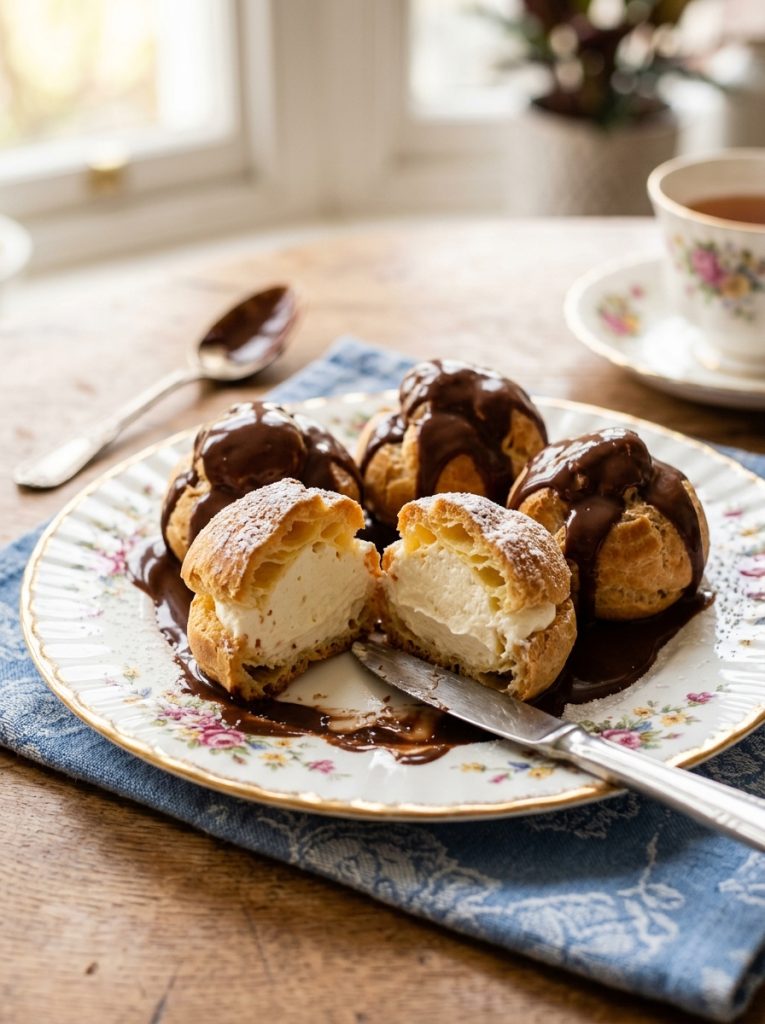
Transfer to a piping bag fitted with a small plain nozzle. Pierce the base of each profiterole with the nozzle and pipe cream inside until the profiterole feels heavy and slightly rounded. Alternatively, split each profiterole in half with a serrated knife and spoon cream generously into the bottom half.
Step 5 — Assemble and Serve
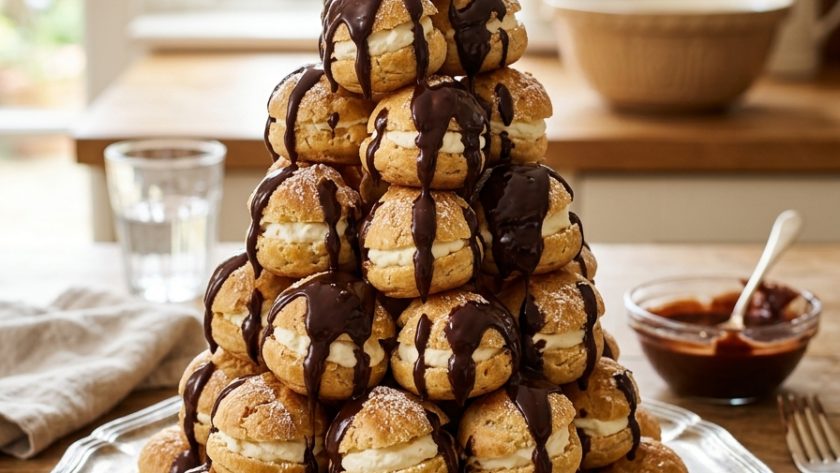
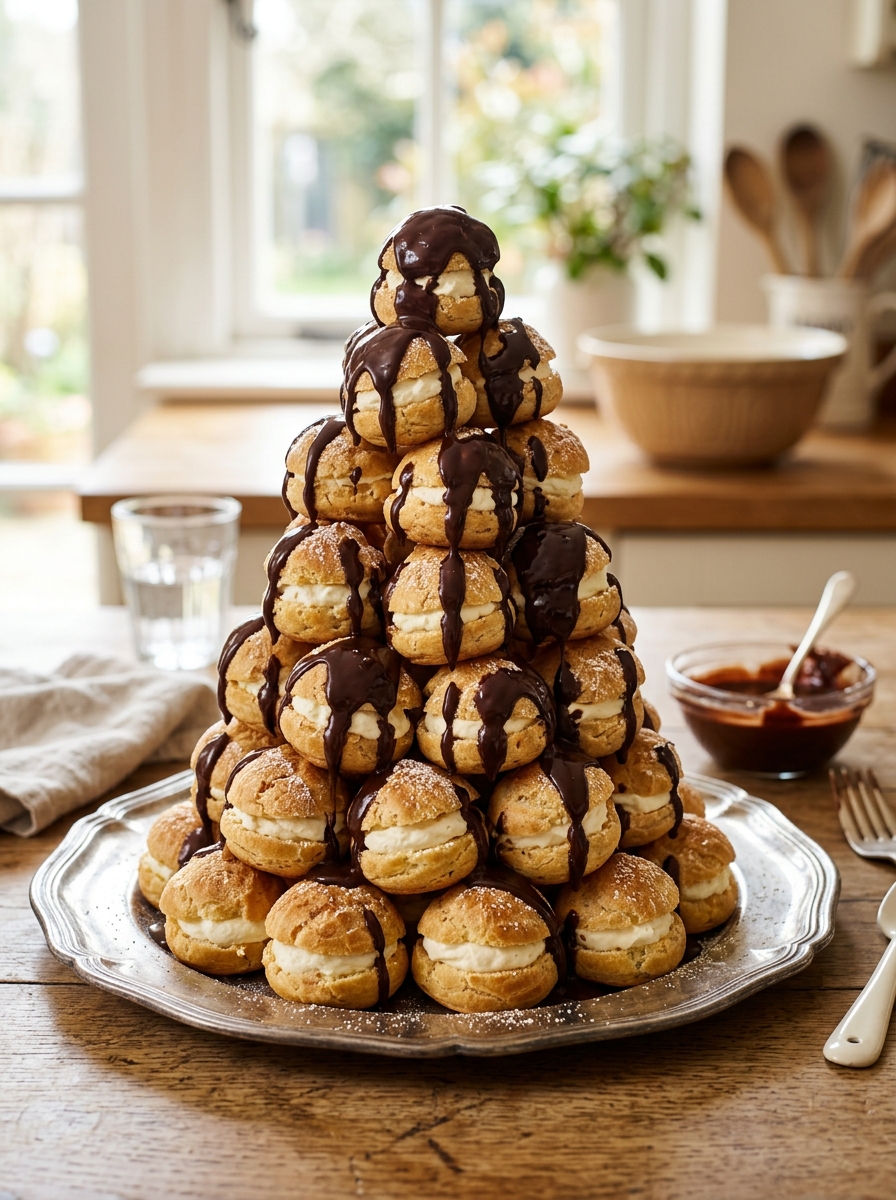
Pile the filled profiteroles into a pyramid on a serving plate or in a large bowl. Pour the chocolate sauce generously over the top — let it run naturally between and over the profiteroles.
Serve immediately, with extra chocolate sauce alongside.
Tips For Best Mary Berry Profiteroles
The flour must go in all at once the moment the liquid boils. Adding the flour gradually gives an uneven paste that does not come together properly. Sift the flour onto baking parchment before starting and tip all of it in at once the moment the water and butter reaches a full boil and is removed from the heat.
Do not open the oven door before 20 minutes. The rise of a profiterole depends entirely on the steam generated inside the pastry by the water content. A drop in oven temperature — even briefly — causes the steam pressure to drop and the profiteroles to collapse. Set a timer and do not touch the oven door until the minimum time has passed.
Pierce the base immediately when they come out. Steam trapped inside a profiterole that is not released immediately creates a slightly soggy centre as it condenses. Piercing the base with a skewer the moment they leave the oven releases the steam and gives a crisp, dry interior ready for the cream filling.
The paste must be cool enough before the eggs go in. Paste that is too hot partially cooks the eggs as they are added, giving a slightly scrambled texture rather than the smooth, glossy paste that the cream-filled profiteroles need. Two to three minutes of cooling after the ball has formed is sufficient.
The chocolate sauce can be made ahead and gently rewarmed. The sauce sets slightly as it cools. Placed in a saucepan over the lowest possible heat and stirred gently, it returns to perfect pouring consistency within two minutes.
Serving Suggestions
Piled into a pyramid with warm chocolate sauce drizzled over — the classic presentation. In individual bowls with three to four profiteroles per person and extra sauce. At a dinner party as the dessert course — they look spectacular and can be almost entirely prepared ahead.
How to Store Mary Berry Profiteroles
Unfilled choux buns: Store in an airtight container at room temperature for up to 2 days. Refresh in a 180°C oven for five minutes if they have softened — this re-crisps the pastry. Fill immediately before serving.
Filled profiteroles: Best eaten within two hours of filling. The cream softens the choux pastry over time.
In the freezer: Freeze unfilled choux buns for up to 3 months. Defrost at room temperature for thirty minutes — refresh in the oven for five minutes. Fill and sauce fresh.
Mary Berry Profiteroles Recipe
Ingredients
Method
- Preheat oven to 200°C / 180°C fan / Gas 6. Line two baking trays with parchment.
- Heat water and butter until butter melts. Bring to a vigorous rolling boil — remove from heat immediately. Tip all flour in at once — beat vigorously until a smooth ball forms and pulls away from the pan. Beat 1–2 minutes. Cool 2–3 minutes.
- Add beaten egg a quarter at a time — beat very vigorously after each addition until smooth and glossy. Paste should drop reluctantly from the spoon.
- Pipe or spoon 3cm rounds onto trays — space well apart. Bake 22–25 minutes until deeply golden, puffed, and firm. Do not open oven before 20 minutes. Pierce each base immediately with a skewer on removing from oven. Cool completely on a wire rack.
- Heat cream and syrup to just simmering — pour over chopped chocolate. Stand 2 minutes. Stir smooth. Add vanilla.
- Whip cold cream, icing sugar, and vanilla to firm peaks. Pipe into each profiterole through the pierced base until heavy. Pile onto a serving plate. Pour chocolate sauce generously over the top. Serve immediately.
Notes
Frequently Asked Questions
Why did my profiteroles not rise?
The most common causes are: the oven was opened too early, the paste was too stiff (not enough egg), or the butter and water mixture was not at a full rolling boil when the flour was added. All three prevent the steam from building properly inside the pastry.
Can I use milk chocolate for the sauce?
Yes — milk chocolate gives a sweeter, less intense sauce. Use the same quantity and reduce the golden syrup to one tablespoon.
Can I fill them with ice cream instead of cream?
Yes — a small scoop of vanilla ice cream pushed inside each profiterole gives a slightly different but very good result. Serve immediately — the ice cream melts quickly in a warm room.
Can I make the choux paste ahead?
The choux paste can be made and refrigerated for up to two hours before piping. Bring back to room temperature and beat briefly before piping — it firms slightly in the fridge.













Leave a Reply