
 Anna Louise
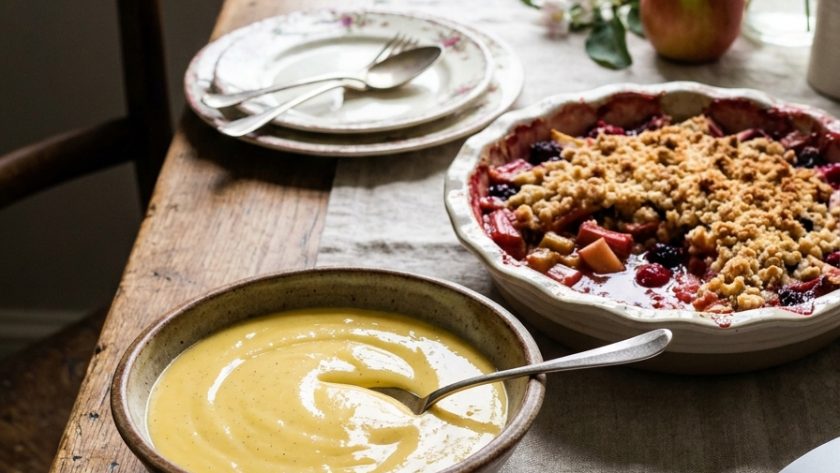
Proper homemade custard — crème anglaise — is one of the most useful and most rewarding things in the dessert kitchen. It takes fifteen minutes, uses five ingredients, and transforms every British pudding it accompanies.
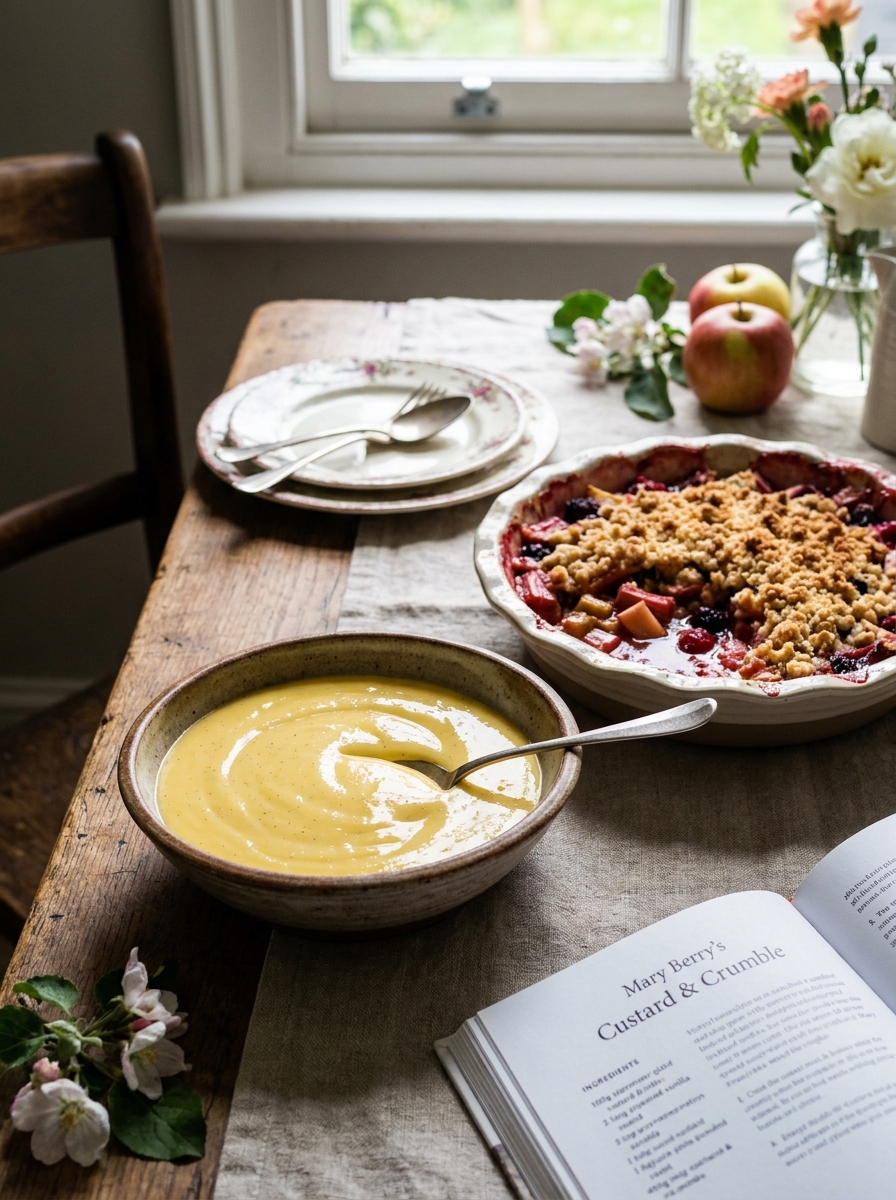
Poured over Eve’s pudding, apple crumble, bread and butter pudding, or steamed treacle sponge, proper custard made from scratch gives a result that is in a completely different category from the carton or the tin.
The technique has one critical rule: keep the heat low and stir constantly. Custard that is heated too quickly scrambles the egg yolks and gives a slightly grainy, curdled result that cannot be recovered.
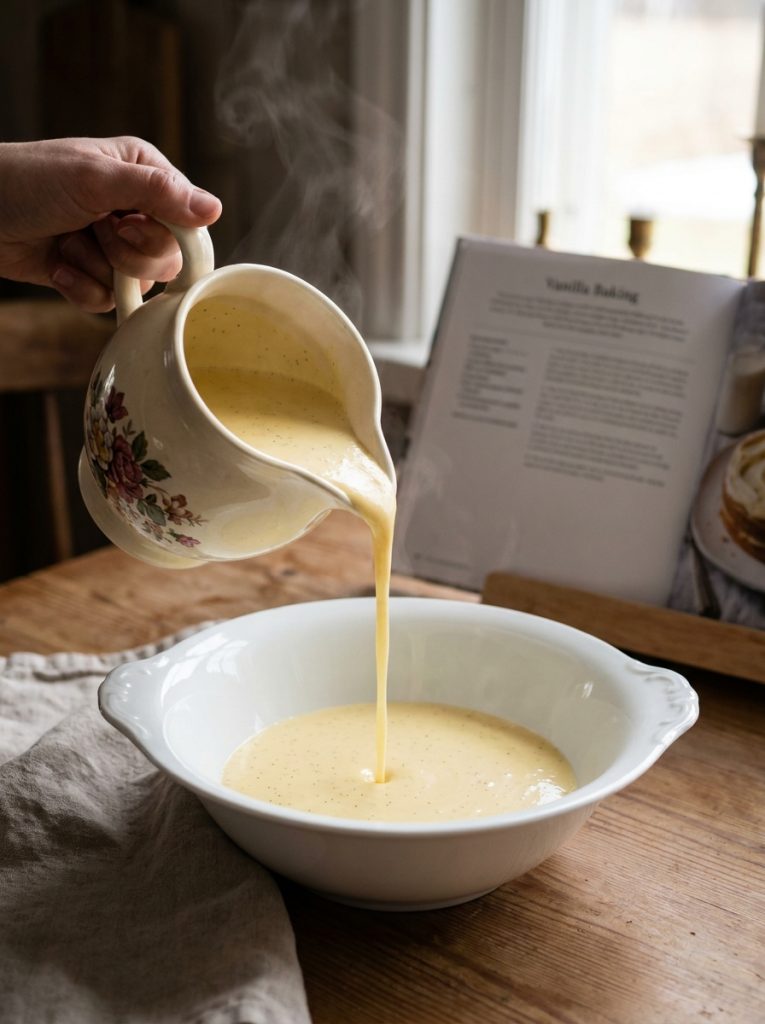
Custard heated gently and stirred patiently gives a silky, smooth, glossy sauce that coats the spoon in a thin, even layer — the classic nappé consistency — and pours in a warm, golden stream over whatever it accompanies.
Ingredients for Mary Berry Custard (Serves 6)
For the Custard
- 6 large egg yolks — at room temperature
- 75g golden caster sugar
- 2 tsp cornflour — gives additional stability and helps prevent scrambling
- 300ml whole milk
- 300ml double cream
- 1 vanilla pod, split and scraped — or 2 tsp good quality vanilla extract
- Pinch of fine salt
How to Make Mary Berry Custard
Step 1 — Infuse the Milk and Cream
Place the whole milk, double cream, split vanilla pod and seeds (or vanilla extract), and pinch of salt in a medium saucepan. Heat over a medium-low heat until the mixture just begins to steam and small bubbles appear around the edges — do not allow it to boil. Remove from the heat.
If using a vanilla pod, leave to infuse for ten minutes. This gives a more fragrant, more deeply vanilla-flavoured custard.
Step 2 — Whisk the Egg Yolks
Whisk the egg yolks, golden caster sugar, and cornflour together in a large heatproof bowl for two to three minutes until very pale, thick, and ribbon-like. The cornflour is a small insurance policy — it gives the custard additional stability during heating and reduces the chance of scrambling.
Step 3 — Temper the Egg Yolks
This is the critical step. Pour the hot milk and cream mixture onto the egg yolk mixture slowly — whisking constantly. Pour in a thin, steady stream at first, then more quickly once the egg yolks have warmed up. This tempering raises the temperature of the egg yolks gradually, preventing them from scrambling when they go back into the heat.
Remove the vanilla pod if using.
Step 4 — Cook to Nappé
Return the entire mixture to the saucepan over a low heat. Cook, stirring constantly with a wooden spoon or silicone spatula — making figure-of-eight movements across the base and sides of the pan — for eight to twelve minutes. The custard is ready when it coats the back of the spoon in a thin, even layer and a finger drawn across the back of the spoon leaves a clean line that does not flood back. This is nappé consistency.
Do not rush this. The custard must not boil. If you see any sign of steaming more aggressively, remove from the heat immediately and stir vigorously.
Step 5 — Strain and Serve
Pour through a fine sieve into a warm jug — straining removes any small egg fragments and gives a perfectly smooth custard. Serve immediately, warm, poured generously over the chosen pudding.
My Top Tips For Perfect Mary Berry Custard
Use a combination of milk and double cream. All milk gives a thin, slightly flat custard. All cream gives something too rich and too heavy for a pouring custard. Half and half — 300ml each — gives the right richness, the right viscosity, and the right flavour.
The cornflour is a small but important insurance policy. Two teaspoons of cornflour whisked into the egg yolks give the custard additional stability at higher temperatures — reducing the risk of scrambling and giving a more reliably smooth result. It does not change the flavour or the texture at the quantities used here.
Temper the egg yolks — do not add them to boiling milk. The tempering step — pouring hot milk onto egg yolks in a slow stream while whisking — is what prevents scrambling. It must be done carefully, with constant whisking, and the milk must be hot but not boiling.
Stir constantly and keep the heat low. These two instructions together give a custard that sets properly without scrambling. The moment stirring stops or the heat increases, scrambling begins. Stay at the pan, keep the heat at its lowest setting, and stir until nappé is reached.
If the custard begins to look grainy — act immediately. Remove from the heat, pour into a cold bowl through a sieve, and whisk vigorously. This can rescue the beginning of scrambling. If the custard is fully scrambled, it cannot be recovered.
Serving Suggestions
Poured warm over apple crumble, Eve’s pudding, bread and butter pudding, steamed sponge puddings, mince pies, or any British pudding. As the base for ice cream. As a sauce alongside tarts.
How to Store Mary Berry Custard
In the fridge: Store covered with cling film pressed directly onto the surface — to prevent a skin forming — for up to 2 days. Reheat very gently, stirring constantly, over a low heat. Add a splash of warm milk if too thick.
Mary Berry Custard Recipe
Ingredients
Method
- Heat milk, cream, vanilla, and salt over medium-low heat until just steaming. Remove from heat — infuse 10 minutes if using a pod.
- Whisk egg yolks, sugar, and cornflour 2–3 minutes until very pale and ribbon-like.
- Pour hot milk mixture onto egg yolks in a thin, steady stream — whisking constantly throughout. Remove vanilla pod.
- Return to saucepan over the lowest possible heat. Stir constantly with figure-of-eight movements for 8–12 minutes until the custard coats the back of the spoon and a finger drawn across leaves a clean line. Do not boil.
- Pour through a fine sieve into a warm jug. Serve immediately poured generously over the chosen pudding.
Notes
Frequently Asked Questions
Can I use vanilla extract instead of a pod?
Yes — two teaspoons of good quality vanilla extract added with the salt gives a very good result. A vanilla pod gives a slightly more fragrant, slightly more complex flavour and the characteristic speckle of vanilla seeds.
Can I make this ahead?
Yes — make up to two days ahead and refrigerate. Press cling film directly onto the surface of the custard while still warm to prevent a skin forming.
Can I make a thicker custard for pouring over trifle?
Yes — increase the cornflour to four teaspoons for a thicker pouring custard that holds its shape slightly more in a trifle.
My custard has scrambled — what do I do?
Strain through a fine sieve immediately — small egg fragments can be removed. For a more significantly scrambled custard, blend briefly with a stick blender, then strain. Prevention is always preferable.
















Leave a Reply