
 Anna Louise
 Yorkshire pudding is one of those things where the quantity matters a great deal. Too much batter in the tin and the puddings do not rise properly. Too little and you end up with something flat and thin.
The standard recipe with three or four eggs is ideal for four to six people. But when there are two or three of you and you want proper Yorkshire puddings rather than a mountain of leftovers, you need a smaller batch.
This is that batch. Two eggs, scaled properly, with exactly the right amount of milk, water, and flour. The same rules apply as every Yorkshire pudding recipe on this site — smoking hot fat, rested batter, oven door stays closed — but calibrated for a twelve-hole muffin tin where you fill six holes rather than twelve.
I make this version more often than the full batch. It gives six individual Yorkshire puddings which is exactly right for two people with three each, or three people with two each.
And because it uses the same equal-volumes principle — the same volume of eggs as milk and water combined, and the same volume again of flour — it scales up or down reliably whenever you need it to.
The Equal Volumes Principle — Always
This is the most important thing to know about Yorkshire pudding at any scale.
Crack your eggs into a measuring jug. Note the volume. Use exactly the same total volume of liquid — half milk, half cold water. Use exactly the same volume of flour.
Two large eggs typically measure about 100ml. So you use 50ml milk and 50ml cold water, and 100ml of flour measured by volume (which is about 60g by weight). These ratios give consistently well-risen, crispy Yorkshire puddings every single time.
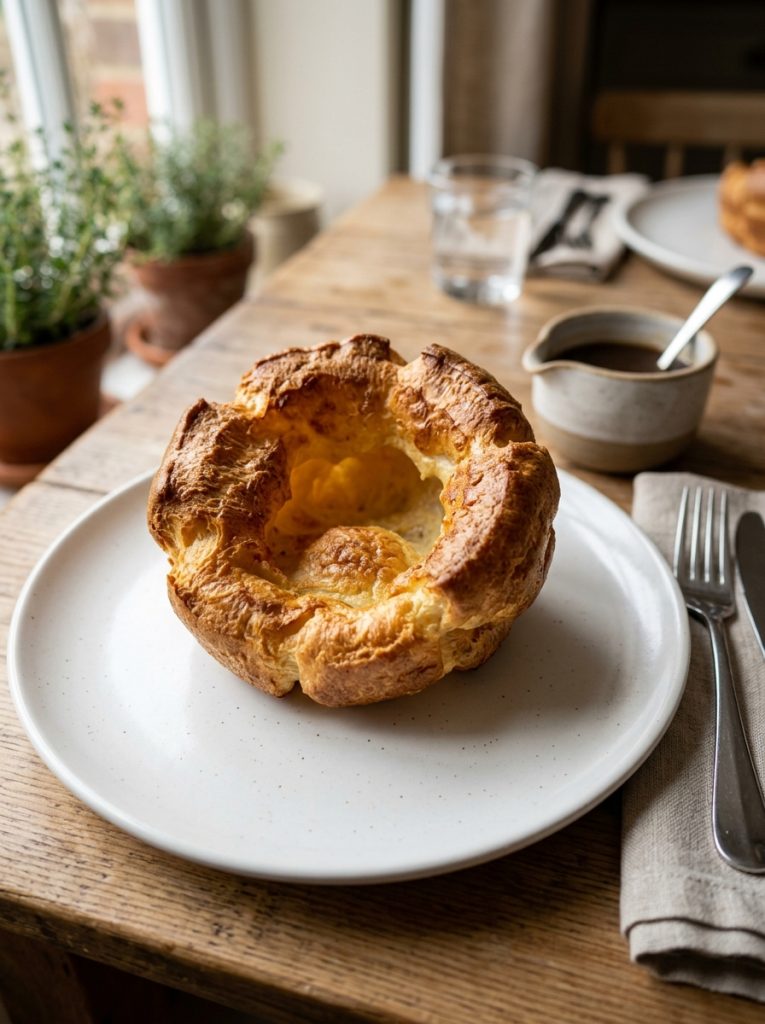
Ingredients for Mary Berry 2 Egg Yorkshire Pudding
- 2 large eggs
- 50ml whole milk
- 50ml cold water
- Approximately 60g plain flour (measure 100ml by volume in a jug for the most accurate result)
- Good pinch of fine salt
- Sunflower or vegetable oil — 1 tsp per hole (6 tsp total for a 6-hole batch)
How to Make Mary Berry 2 Egg Yorkshire Pudding
Step 1 — Make and Rest the Batter
Crack both eggs into a jug — note the volume. In a large bowl or jug, beat the eggs lightly. Add the milk and cold water and whisk together.
Sift the flour and salt into the liquid. Whisk vigorously until the batter is completely smooth and the consistency of thin single cream. There should be no lumps at all.
Cover and rest for at least 30 minutes at room temperature. Overnight in the fridge is better — the batter becomes more reliable and the puddings rise more dramatically. If using from the fridge, bring out 20 minutes before needed and stir well.
Step 2 — Preheat the Oven and the Fat
Preheat your oven to 230°C / 210°C fan / Gas 8. This temperature is not optional — Yorkshire puddings need very high heat.
Add one teaspoon of sunflower oil to each of six holes in a twelve-hole muffin tin. Place the tin on the highest shelf of the oven for at least ten minutes until the oil is smoking. The oil must be visibly smoking when the batter goes in.
Step 3 — Fill and Bake
Have your batter in a jug with a pouring lip — ready beside the oven. Working as quickly as possible — every second the tin is out of the oven the oil is cooling — remove the tin and pour batter into each of the six oiled holes, filling each about halfway.
The batter should sizzle dramatically when it hits the smoking oil. If it does not, the oil was not hot enough.
Return immediately to the highest shelf of the oven.
Bake for 20 to 22 minutes until the puddings are dramatically risen, deep golden brown all over, and crispy. Do not open the oven door at any point. Not once.
Step 4 — Serve Immediately
Yorkshire puddings begin to deflate within minutes of coming out of the oven. Serve immediately — directly from the tin to the table.
My Top Tips For Mary Berry 2 Egg Yorkshire Pudding
Measure flour by volume for the most accurate result. Scooping flour compacts it and gives you too much. Spooning it into a measuring jug gives you the correct volume every time. 100ml of flour measured by volume rather than weight is the most reliable approach.
Half milk, half cold water. All milk gives a slightly richer, slightly softer pudding. Half milk and half cold water gives a lighter, crispier pudding with a thinner, more dramatically risen shell. I always use the half-and-half combination.
The oil must be smoking. Not warm. Not hot. Smoking. This is what makes the batter set immediately on contact with the tin and gives the dramatic rise. If the oil is not smoking, the batter sinks to the bottom and the puddings come out flat and dense.
Thirty seconds from tin to batter to oven. Once the tin comes out of the oven, the oil starts cooling immediately. Have everything ready — batter in a jug beside the oven, oven door open — and move as fast as you can. Thirty seconds maximum.
Oven door stays closed. For the full 20 to 22 minutes. Opening the door even once causes the puddings to deflate immediately and they will not recover.
Serving Suggestions
As part of a classic British roast dinner — beef, gravy, vegetables. Filled with leftover roast dinner ingredients for a creative Monday supper. As a starter with onion gravy poured inside. On their own, hot from the tin, eaten immediately before anyone notices.
How to Store Mary Berry 2 Egg Yorkshire Pudding
At room temperature: Best eaten immediately — Yorkshire puddings are at their absolute best the moment they come out of the oven. Store in an airtight container for up to 2 days — reheat in a 220°C oven for 5 minutes to restore crispness.
In the freezer: Freeze in an airtight container for up to 3 months. Reheat from frozen in a 220°C oven for 8 to 10 minutes.
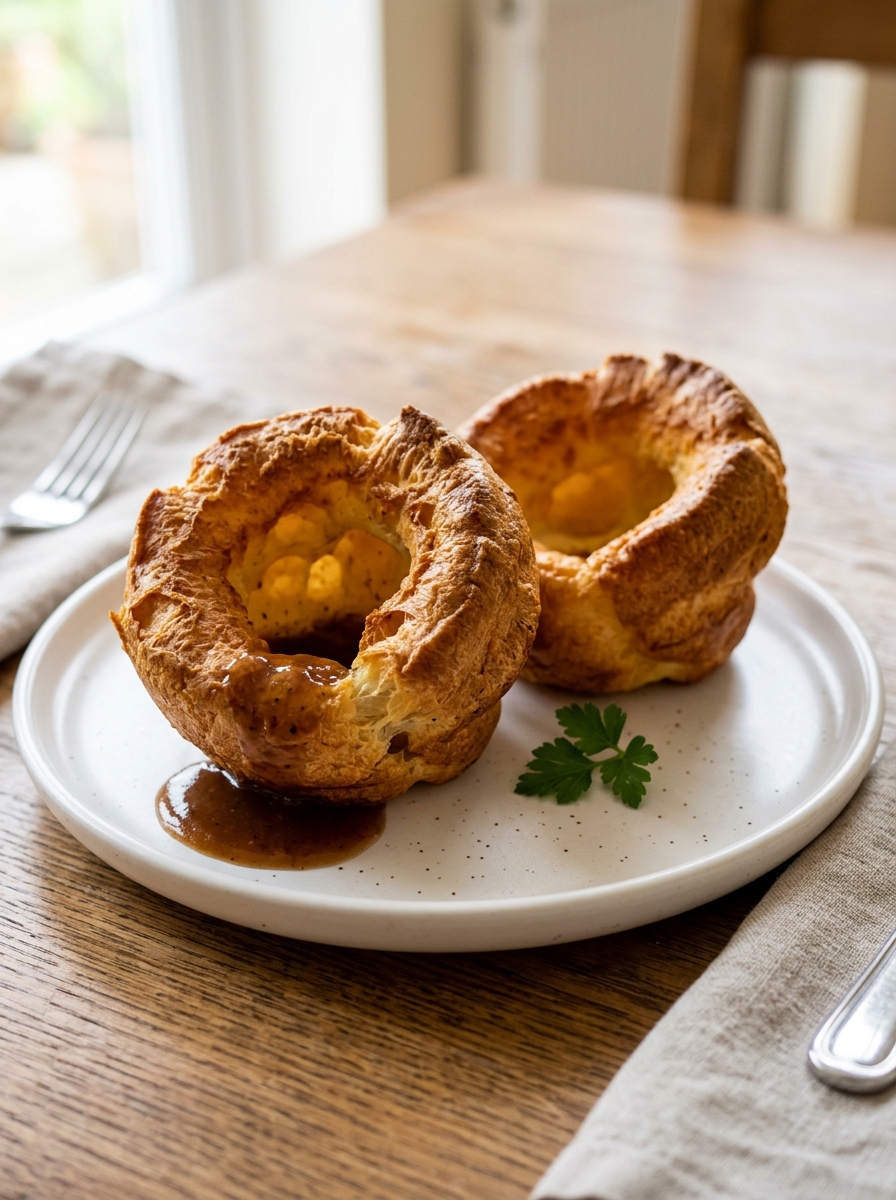
Mary Berry 2 Egg Yorkshire Pudding Recipe
Ingredients
Method
- Beat eggs in a jug. Add milk and cold water — whisk together. Sift in flour and salt. Whisk vigorously until completely smooth — consistency of thin single cream. Rest 30 minutes minimum covered at room temperature — overnight in fridge is better.
- Preheat oven to 230°C / 210°C fan / Gas 8. Add 1 tsp oil to each of 6 holes in a muffin tin. Heat on highest shelf for at least 10 minutes until smoking.
- Working immediately and very quickly — pour batter into the 6 oiled holes, filling each about halfway. The batter must sizzle on contact. Return to oven immediately.
- Bake 20–22 minutes until dramatically risen, deeply golden, and crispy all over. Do not open the oven door at any point.
- Serve immediately.
Notes
Frequently Asked Questions
Can I scale this up for more people?
Yes — use the equal volumes principle. Three eggs (approximately 150ml) = 75ml milk + 75ml water + 150ml flour. Four eggs (approximately 200ml) = 100ml milk + 100ml water + 200ml flour. The ratio is always the same.
Why are my Yorkshire puddings not rising?
The most common causes: oil not hot enough or smoking, batter too cold when it went in, oven door opened during baking. Address all three.
Can I use lard instead of sunflower oil?
Yes — lard was the traditional fat for Yorkshire pudding and gives an even crispier result. It reaches a higher temperature than sunflower oil. Use one teaspoon per hole exactly as directed.
Can I use a 4-hole Yorkshire pudding tin instead?
Yes — use 1½ teaspoons of oil per hole and fill each hole to about half full. The puddings will be larger and need 22 to 26 minutes. See the 4-hole Yorkshire pudding recipe on this site for full guidance.
My batter is lumpy — is it still usable?
Lumpy batter gives uneven puddings. If you spot lumps, press the batter through a fine sieve before resting. Next time, sift the flour before adding and whisk more vigorously.


Leave a Reply